
Best Dental SEO Companies in 2026 and How to Choose One
Key Takeaway: Choosing the best dental SEO company in 2026 requires evaluating providers on seven specific criteria: pricing transparency, contract flexibility, dental-specific specialization, audit methodology, GBP fluency, reporting clarity, and ownership of deliverables. Most providers fail at least three of these. This guide gives you the criteria, the red flags to walk away from, and the exact questions to ask any agency before signing a contract.
In 90 Seconds: The Quick Answer
If you only have a minute, here’s the short version:
- Most “best dental SEO companies” listicles are written by agencies that rank themselves #1. This is the exact pattern that Google has been algorithmically demoting since January 2026, and that the FTC’s Consumer Review Rule has targeted since October 2024.
- Our May 2026 audit of 10 named dental marketing agencies found: only 1 of 10 publishes pricing publicly, 0 of 10 publish contract terms, 9 of 10 have no documented audit methodology, and 2 of 10 publish self-promotional “best of” content ranking themselves #1.
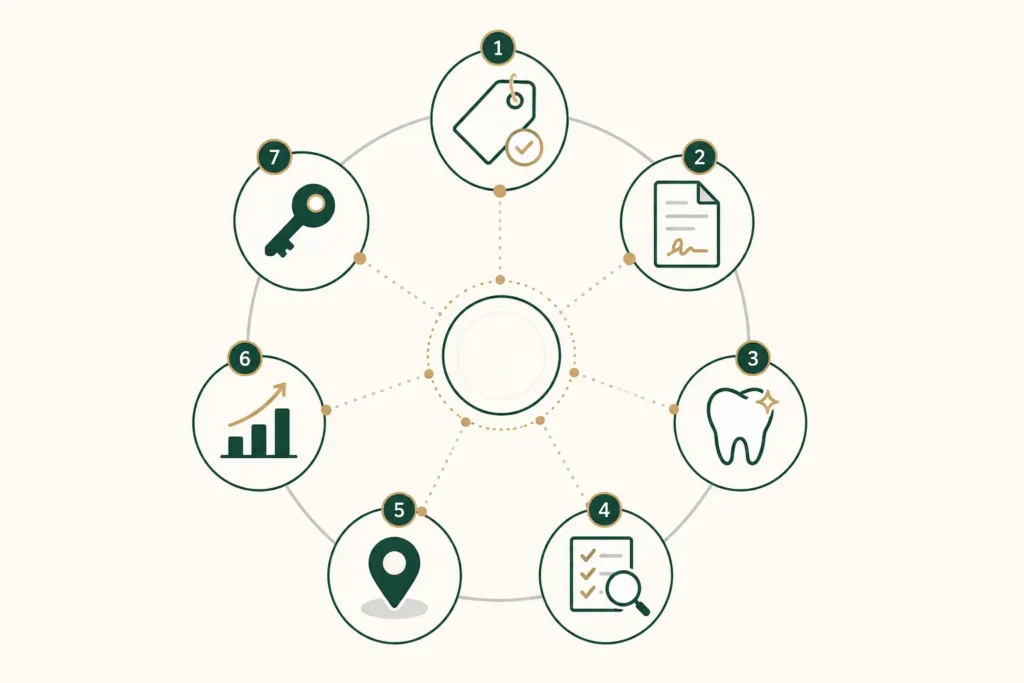
- Evaluate any agency on seven criteria: pricing transparency, contract flexibility, dental-only specialization, audit methodology, GBP fluency, reporting clarity, and ownership of deliverables. The first four are testable in 15 minutes from public information; the last three require one sales call.
- Walk away from: $199-499/month tiers, 12+ month auto-renewing contracts, “we’ll do a free audit” without a methodology, and any agency that guarantees specific rankings.
- How to build your shortlist: apply the seven criteria to candidate providers in 15 minutes per site, eliminate any with two or more red flags, then run the ten-question list on the survivors. The framework section below shows the audit findings; the shortlist process shows how to apply them.
Why Most “Best Dental SEO Companies” Lists Are Misleading
Open a Google search for “best dental SEO companies” and look at the first ten results. A pattern emerges quickly. Most of those articles are written by dental marketing agencies that rank themselves at the #1 position. The remaining nine spots belong to competitors the author has often never used, never tested, and in some cases never even spoken with.
This pattern creates two specific problems that became more serious in 2026.
The first is regulatory. Since October 2024, the FTC’s Consumer Review Rule (16 CFR Part 465) prohibits companies from presenting their own controlled content as independent reviews, and from publishing reviews of services they never actually used. Penalties run up to $53,088 per violation, per page. A “best of” listicle written by an agency that includes itself, or that ranks competitors based on no real testing, falls within the practices the rule is designed to address.
The second is algorithmic. In January 2026, Google rolled out a non-announced core update that targeted self-promotional listicles specifically. Search industry analysts Lily Ray (Amsive) and Glenn Gabe (G-Squared Interactive) tracked the impact: sites publishing “best X” lists where the author appeared at #1 saw direct ranking drops, often correlated with simultaneous losses in AI Overview citation. Year-swap freshness (just updating “2025” to “2026”) stopped working. Reciprocal listicle networks between agencies were detected and demoted.
To verify how the industry actually behaves on basic transparency, our May 2026 audit reviewed 10 well-known dental marketing agencies serving the U.S. market. The results were striking. Only 1 of 10 publishes pricing on its own website. 0 of 10 publish their contract length terms. 9 of 10 don’t define a specific audit methodology anywhere on their site. 2 of 10 publish self-promotional “best of” content where they rank themselves #1, which is the exact pattern Google has been demoting.
Interestingly, the one agency that publishes its pricing also publishes a self-promotional “best of” article ranking itself #1. Transparency on one dimension doesn’t predict transparency on others. Evaluate each agency on each criterion separately.
What the May 2026 Audit Found: Side-by-Side
The table below summarizes the audit results across all 10 agencies on the four criteria we tested directly from public information. The last three criteria from our framework (GBP fluency, reporting clarity, ownership terms) typically require a direct sales conversation and aren’t included in the public-information audit.
| Criterion | Result (out of 10) | What the data shows |
|---|---|---|
| Pricing visible on the agency’s own site | 1 of 10 | One agency publishes tiers ($500-$2,000/month for organic services). Two agencies show partial pricing for specific limited programs. Seven require an intro call before disclosing any range. |
| Contract terms visible (minimum commitment, auto-renewal clauses) | 0 of 10 | No agency in the audit publishes minimum commitment length or auto-renewal terms on its public-facing site. |
| Audit methodology documented (checklist, framework, sample deliverable) | 0 of 10 | No agency publishes a specific audit checklist or sample deliverable on its own site. “Free audit” offers exist, but the methodology behind them isn’t documented. |
| Self-promotional “best of” content with self at #1 | 2 of 10 | Two agencies publish content where they appear at the top of a “best agencies” ranking. Both correspond to the FTC-flagged and Google-demoted pattern described above. |
What the table shows: the dental marketing agency industry has a structural problem with basic transparency. Even when we narrow to four objectively testable criteria, the public-facing data is sparse. The single agency that publishes its pricing also publishes a self-promotional “best of” article ranking itself #1. There’s no single “transparency leader” across all four dimensions. This is why a criterion-based framework (covered below) outperforms any agency-ranking shortcut, and why this article doesn’t include one.
Full disclosure: we run a dental SEO agency. Ranking ourselves in this article would make it useless to you, for two reasons. First, agency self-ranking is exactly the practice the FTC rule targets and the practice Google has been algorithmically demoting. Second, even if neither regulator existed, you have no reason to trust a “best of” list written by one of the companies on the list.
Here’s what we’re doing instead. The seven criteria below are how we’ve come to think about what differentiates strong dental SEO providers from weak ones. They represent what we believe distinguishes the best dental SEO companies from the rest of the market. We meet all seven, which is part of why we built the framework around them. The trade-offs that come with hiring a specialist like us are a separate matter, covered in a later section. The criteria themselves don’t favor us specifically; they favor a category of provider (the dental-only specialist) over generalist alternatives, and they’re equally useful when evaluating our competitors.
What Should You Actually Look for in a Dental SEO Company?
Most dental practices come to an agency search overwhelmed, because the market quality varies dramatically. AI-generated content has flooded the lower tier of the market, while serious specialists have raised the bar at the top.
The framework below covers seven areas where strong providers consistently differ from weak ones. Most of the criteria are testable from public information on the agency’s website in fifteen minutes; the last three (GBP fluency, reporting clarity, and ownership terms) typically require one direct conversation with a sales representative.
The Seven-Criterion Framework
| # | Criterion | What to look for | What to walk away from |
|---|---|---|---|
| 1 | Pricing transparency | Published price tiers, scope clarity | Custom-quote only, “depends on your needs” |
| 2 | Contract flexibility | Month-to-month or 6-month max, clear exit terms | 12+ month contracts, auto-renewal traps |
| 3 | Dental-specific specialization | Majority dental clients, named dental case studies | “We do dental and 30 other industries” |
| 4 | Audit methodology | Specific issues with priority and impact | Vague “we’ll do an audit” with no methodology |
| 5 | GBP fluency | Concrete GBP optimization deliverables | “We’ll manage your Google listing” only |
| 6 | Reporting clarity | Keyword-level plus lead-attribution metrics | Vanity metrics (traffic, DA, impressions) |
| 7 | Ownership of deliverables | You own content, accounts, data | Agency-locked content, agency-owned GBP |
These criteria aren’t equally weighted for every practice. A solo general dentist in a competitive metro will weight pricing transparency and GBP fluency higher than a multi-location specialty group focused on enterprise-scale operations. A new practice owner concerned about long-term independence will weight ownership of deliverables very highly. A practice burned by a previous agency will weight contract flexibility and audit methodology heavily.
How to Weight the Criteria for Your Practice Type
The table below shows which three criteria typically matter most for each practice profile, plus the realistic pricing tier most likely to fit. Use it as a starting point, not a rule.
| Practice profile | Top three criteria to weight | Realistic pricing tier |
|---|---|---|
| Solo general dentist, established | Pricing transparency, GBP fluency, Reporting clarity | Foundation to Growth |
| Single-location cosmetic or specialty practice | Dental specialization, Audit methodology, Reporting clarity | Growth to Authority |
| New practice owner (under 2 years) | Contract flexibility, Ownership of deliverables, Pricing transparency | Foundation |
| Multi-location group (2-9 locations) | Audit methodology, Reporting clarity, Ownership of deliverables | Authority to Enterprise |
| DSO (10+ locations) | Audit methodology, Reporting clarity, Contract scoping | Enterprise |
Walk through each of the seven before requesting a proposal. Then ask the agency directly about any criterion the website doesn’t address. If you’d like a reference for how to choose a dental SEO company in detail, the section below walks through each criterion. You can also see what a proper dental SEO audit actually checks and how to evaluate which keywords an agency targets for two areas where evaluation gets technical quickly.
The Seven Criteria of the Best Dental SEO Companies, in Depth
1. Pricing Transparency
Pricing transparency in this industry is rare. From the agencies in our May 2026 audit, only one publishes its tiers on its own site. The other nine require an intro call before disclosing any price range.
Why this matters: agencies hiding pricing typically segment prospects to anchor the conversation around their perceived budget, not their needs. A practice that walks in willing to spend $4,000/month gets a $4,000/month proposal. The same practice walking in willing to spend $1,500 gets a $1,500 proposal, often for the same scope of work, just delivered with less time and lower-quality content.
A confident agency publishes its tiers. The price might be a starting band ($1,500-$2,500/month for foundation-tier services) rather than a single number, but the band tells you something useful before the call.
Question to ask: What are your tier ranges, and what specifically differs between them?
2. Contract Flexibility
Twelve-month contracts with auto-renewal are common in the dental marketing industry. They shouldn’t be. Organic search results begin to appear meaningfully in months 3-6, so a six-month commitment is reasonable. Beyond that, the contract starts protecting the agency more than the client.
Watch for two specific traps. First, auto-renewal clauses that require 30 or 60 days’ written notice before the renewal date. Practices regularly miss these windows and find themselves locked into a second year. Second, exit penalties that recover “prepaid” work or charge cancellation fees disproportionate to remaining services.
The healthiest contract structure is a 6-month initial commitment with explicit performance benchmarks at month 6, then month-to-month afterward. For complex enterprise or DSO engagements, longer terms can be appropriate, but only if tied to specific deliverable milestones.
What to verify before signing: Get the minimum commitment, the renewal notification window, and any exit penalties in writing. Verbal assurances mean nothing once the contract is countersigned.
3. Dental-Specific Specialization
Specialization shows up in three places: the client roster, the case studies, and the content. An agency with a majority dental client base develops pattern recognition around keyword intent (“emergency dentist” converts differently than “cosmetic dentist near me”), patient journey stages (urgent vs. elective procedures), and content compliance requirements around healthcare claims.
A generalist firm serving HVAC, law firms, and dental practices applies a generic local search playbook to each. The playbook works at a baseline level, but misses where dental search behavior diverges. Patients searching for endodontists vs. orthodontists vs. periodontists have different intent, urgency, and conversion economics.
Practices with a heavy implant caseload should ask providers specifically about implant landing page conversion and HIPAA-compliant before-and-after handling. Our dental implant marketing guide covers what good looks like in both areas.
Watch for case studies that name specific dental practices and specific results. “A dental practice in Texas grew 40%” is a marketing statement. A real case study names the practice, the timeframe, and the specific metric.
How to test this: Ask what percentage of the agency’s current clients are dental practices. If the answer is below 50%, the agency probably applies generalist methods. If they hesitate to give a number, that’s also an answer.
4. Audit Methodology
This is where most providers fail quietly. In our May 2026 audit, none of the ten agencies publishes a specific audit methodology on its site. Most offer a “free SEO audit” without explaining what they review, in what order, or against what benchmarks. The “free audit” is often a sales discovery call dressed up.
A useful audit covers four areas at a minimum:
- Technical performance (Core Web Vitals, mobile usability, indexation)
- Content gap analysis (keyword coverage vs. local competitors)
- Google Business Profile evaluation (completeness, photo strategy, review velocity)
- Backlink profile assessment (referring domains quality, anchor text distribution)
It takes 1-3 hours of expert review, comes back with a prioritized issue list, and includes time-to-fix estimates. Ask any agency offering a “free audit” to describe the audit checklist before they look at your site. If the answer is vague, the work behind it will be too.
Question to ask: Can I see a sample of one audit you’ve delivered, with client identifying details removed?
5. GBP Fluency
Google Business Profile drives a disproportionate share of new patient calls for dental practices, often more than the website itself for service queries like “dentist near me” or “emergency dentist [city].” Strong agencies treat GBP as a primary surface, not a check-box.
GBP fluency shows up in specifics. Does the provider manage GBP attributes (services, insurance accepted, languages spoken)? Do they have a defined photo upload cadence? Do they actively manage Q&A and respond to reviews? Do they post weekly updates? Do they monitor GBP suspensions and have a recovery process?
A weak provider will say “we’ll manage your Google listing” and do little more than the initial setup. A fluent one will give you a documented monthly GBP work plan with specific deliverables. For practices in competitive metros, GBP fluency separates the agencies that drive real call volume from the ones that focus only on website ranking. See Google Business Profile optimization specifically for dentists for the technical details.
Get specific: Ask for a documented monthly GBP work plan. Not “we’ll manage GBP” but the actual list of weekly and monthly actions, with hours allocated.
6. Reporting Clarity
Reporting clarity separates accountable agencies from those that hide behind vanity metrics. An accountable monthly report tells you, at minimum: which specific keywords moved up or down and by how much, how many calls and form submissions came from organic search, what the cost per lead was for new patients, and what the agency worked on during the month.
A vanity-metric report shows traffic up and to the right, impressions in the thousands, and Domain Authority scores. These metrics move easily, mean little, and don’t connect to patients booking appointments.
Ask any prospective agency to send you a sample monthly report with client identifying details removed. If they hesitate, you have your answer. If the sample comes back full of traffic charts but light on lead attribution, you have your answer.
For new practices, lead attribution can be technical (call tracking setup, GA4 event configuration). A strong provider handles this setup as part of onboarding and explains the report layout before sending the first one.
Question to ask: Can you send me a sample monthly report from a current client, with their name and identifiers removed?
7. Ownership of Deliverables
One of the agencies in our May 2026 audit stood out for explicit ownership transparency, stating plainly in its public FAQ: “You own your domain, website, copy, and any photos/videos you provide.” Few agencies put this in writing, but most should.
Ownership is the most common source of disputes when dental practices change agencies. Some providers build websites on proprietary platforms that the practice doesn’t own, write content that disappears at contract end, manage GBP under agency credentials that the practice loses access to, and use call-tracking numbers that revert to the provider.
The standard you should require is simple: at any point, on any day, you should be able to walk away and retain your domain, your website code and content, your GBP credentials, your Google Analytics, and your call tracking history.
For practices considering enterprise-platform options, check the ownership terms carefully. The convenience of all-in-one platforms often comes paired with restricted exit rights.
Put this in writing: Make ownership terms explicit in the contract, not just verbal assurance. List every asset, every credential, every account, and confirm in writing that all of it transfers to you on cancellation.
Five Red Flags That Should Make You Walk Away
Some practices research the best dental SEO companies thoroughly before signing; others settle for the first agency that fits their budget. Either way, five patterns appear repeatedly in providers that produce poor results or damaged client relationships. Each of these is a sufficient reason to keep looking, even if the agency has otherwise impressive credentials.
- Guaranteed first-page rankings. Any agency that promises specific ranking results within a specific timeframe either misunderstands Google or is misleading you. Google’s own guidelines state plainly: “Beware of SEOs that claim to guarantee rankings.” Search algorithms are too complex and too dynamic for any third party to guarantee position outcomes. A confident agency promises process and reporting, not specific rankings.
- Pricing tier $199-$499/month. At this price point, comprehensive organic search work is mathematically very difficult. Skilled SEO professionals in the U.S. typically bill $50-$100/hour fully loaded at agency rates. A retainer that delivers technical work, GBP management, content production, link building, and reporting requires 10-15 hours of professional time per month minimum. At $299/month, the agency has roughly $20-$30/hour to work with, which usually means overseas contractors and AI-generated content. This pricing tier is also where complaints and FTC-relevant enforcement risks concentrate, particularly around fabricated case studies and unsubstantiated reviewer testimony.
- 12+ month contracts with auto-renewal. The industry standard is a 6-month initial commitment. Twelve-month contracts with auto-renewal are designed to lock revenue regardless of results. Long contracts with auto-renewal clauses are a recurring source of complaints in industry forums and online review sites, particularly around large multi-service platforms that bundle SEO with practice management software. If a six-month minimum is enough for the agency to demonstrate value, twelve months without exit options is structurally designed to protect the agency.
- Generic template content. A clear sign of low-effort work: blog posts that read like they could apply to HVAC contractors or law firms with minor word substitution. Healthcare content has specific compliance requirements (conservative claims, careful framing of outcomes, evidence-supported comparisons) that generic content templates ignore. Read three or four blog posts before signing. If you can’t tell from the content alone that the author has worked with dentists, the content isn’t dental-specialized.
- No specific audit methodology. When a provider offers a “free audit” but cannot explain what’s reviewed, in what order, against what benchmarks, the audit isn’t an audit. A real audit is methodological and reproducible. Ask for the checklist before they look at your site. If the answer is vague, the work behind it will be too.
A short detour before we go further
If your current agency is showing any of these red flags, or you’re evaluating a new provider against the seven criteria above, our free audit of your site shows you what’s working, what’s broken, and what your top three competitors are doing better. It runs against the same framework laid out in this article. There’s no follow-up sales pressure.
How to Build Your Own Shortlist
The seven criteria, the five red flags, and the ten questions in this article are most useful in combination. Skip the temptation to start with “who’s the best?” and start instead with “what process gets me to a confident decision?” Use the following five steps.
- Generate an initial candidate list of 5-10 providers. Sources include Google search results (filtering out self-promotional listicles), dental industry directories like UpCity and Clutch, LinkedIn searches for dental marketing specialists, peer recommendations from other practice owners, and referrals from dental conferences. Don’t worry about quality at this stage; quantity gives you something to filter.
- Apply the seven criteria to each candidate’s public website. Allow 15 minutes per agency. Score each criterion as ✓ (clearly visible), ⚠ (partial or unclear), or ✗ (not visible). Eliminate any candidate showing two or more red flags from the section above.
- For the 3-5 candidates that survive Step 2, schedule a sales conversation. Run the ten-question list during that call. Listen for confident, specific answers vs. vague deflections, conditional promises, or “we’ll send you that later” responses. The pattern of how an agency answers tells you more than the answers themselves.
- Ask each finalist for concrete samples. A redacted audit deliverable, a sample monthly report, two or three named dental case studies with specific keyword and lead-volume data, and a sample of content their team has produced. If any finalist resists sharing these, that’s a fast disqualifier.
- Verify ownership and exit terms in writing before signing anything. Get the answer to “what do I retain if I cancel” in the actual contract draft, not in an email or verbal assurance. Read the auto-renewal clause carefully. If the contract is longer than 6 months, verify the milestone-based exit provisions.
This process replaces the question “who’s the #1 best agency offering the best SEO for dentists in 2026?” with a better question: “which specific provider, evaluated against what specifically matters to my practice, is the right fit?” The framework is portable. It works in 2026 and it will work in 2030. The agencies on your initial list will change. The framework will not.
Questions Every Dentist Should Ask Before Signing
The questions you ask matter more than the marketing material on the agency’s website. A confident agency answers all ten without hesitation. A weak one deflects, gives vague answers, or pushes you toward signing first and asking later.
- What’s included in your monthly retainer, and what’s billed separately? Scope creep is the most common source of contract disputes.
- What’s the minimum contract length, and what are the exit terms? Auto-renewal traps are real.
- Who owns the content, accounts, and GBP profile if I cancel? This is the most often-overlooked question.
- What does your monthly report actually show? Can I see a sample?
- What’s your specific methodology for keyword research and prioritization? Ask for the framework, not the talking points.
- How do you handle Google Business Profile optimization specifically? GBP work plans should be documentable monthly deliverables.
- Can you show me a dental client whose rankings improved, with the specific keywords?
- What happens in months 1-3 vs. months 4-12 of working together?
- Who specifically will write my content, and what’s their healthcare or dental experience?
- What’s your policy on guarantees, refunds, and scope changes mid-contract?
The pattern of how an agency answers matters as much as the answers themselves. The table below shows what a confident response sounds like, contrasted with the red-flag version.
How to Read the Answers
| Question | Confident Response | Red Flag Response |
|---|---|---|
| What’s included in your retainer? | Itemized scope sheet with hours and deliverables | “It depends on what you need” |
| Minimum contract length? | “Six months, then month-to-month” | “Twelve months minimum, auto-renews” |
| Audit methodology? | Walks you through the checklist plus a sample | “We’ll know after we look at your site” |
| Sample monthly report? | Shares an anonymized version in the same call | Promises to send later, doesn’t |
| Who writes content? | Names the person and their healthcare experience | “Our team” with no specifics |
| Ownership if I cancel? | “You own everything: domain, content, accounts” | “We’ll work out the details if it comes to that” |
A confident agency gives concrete answers in real time. A weak one defers to the contract or to a follow-up call. Listen for that pattern.
How Much Should Dental SEO Cost in 2026?
The best SEO company for dentists in your situation depends partly on cost. Pricing transparency in this industry remains rare, as discussed in the opening section. The bands below are based on third-party reporting, the agency proposals we’ve reviewed in our work, and the limited public data available.
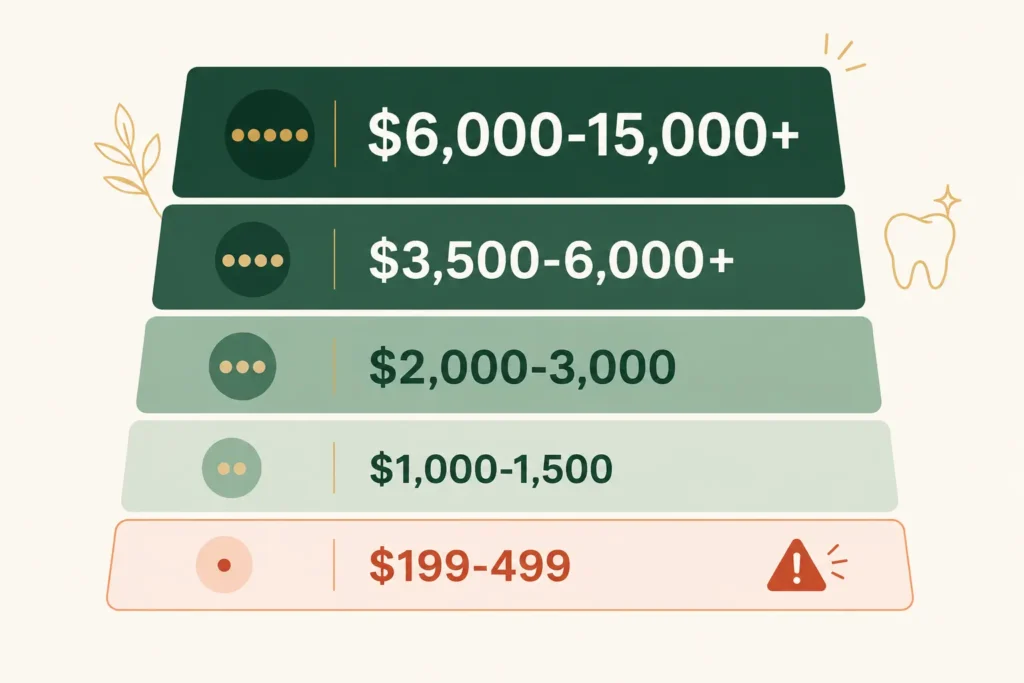
Dental SEO Pricing Tiers: What’s Realistic in 2026
| Tier | Monthly cost | What’s typically included | Best for |
|---|---|---|---|
| Bargain / red flag | $199-$499 | AI-generated content, overseas contractors, minimal optimization | Walk away. This is the price band where FTC enforcement risk and complaint volume concentrate. |
| Foundation (entry-level) | $1,000-$1,500 | Light retainer: technical SEO check, GBP optimization, 2 blog posts/month, basic reporting. Compromises: limited custom content depth, slower response times, fewer hours per month. | Single-chair starter practices, $500K-$1M annual revenue, low-competition markets only. Below the floor for competitive metros. |
| Growth | $2,000-$3,000 | Plus link building, conversion optimization, 4 posts/month | Growing practices, $1-3M annual revenue |
| Authority | $3,500-$6,000+ | Plus strategy consulting, original research, specialty support | Multi-location, specialty practices |
| Enterprise | $6,000-$15,000+ | DSO-scale infrastructure, dedicated team | DSOs, 10+ locations |
Third-party reporting and the agency proposals we’ve reviewed suggest most growth-oriented dental practices pay between $1,500 and $3,500 per month for organic search services. The practices getting actual results don’t always pay the most. They pay for agencies that meet the seven criteria above. A $1,800/month engagement with a specialist who publishes pricing and methodology often outperforms a $4,000/month engagement with a generalist who hides both.
What You Probably Won’t Get From a Specialist Agency (Including Us)
The seven criteria above are the bar that specialist providers tend to clear. Specialists trade certain capabilities for that depth, and you should know what they are before you sign.
- Multi-channel bundling. Most specialist agencies don’t run your paid ads, social media, email marketing, or print campaigns. You’ll either need separate vendors for those or a multi-channel agency that does dental search work less specifically. Decide if integrated workflow matters more than channel depth.
- On-site presence. Specialists are typically remote. If you value in-person meetings, office visits, or local accountability, a regional generalist may suit you better, even at the cost of dental specialization.
- 24/7 support. Solo or small specialist operators work business hours in their time zone. Emergency response on a Sunday afternoon is rare. If you anticipate urgent needs, ask about response-time service-level agreements in writing.
- Established US dental case study volume. Newer specialists, including Dental Rank Lab, are building their case study portfolio. If you need 10+ published US dental case studies before you’ll sign, a longer-established specialist or a large agency may be a better fit.
- Bundled adjacent services. Specialist providers typically don’t handle website redesigns, brand identity, video production, or patient communication systems beyond search-adjacent work.
None of these are deal-breakers if organic search results are your priority. They become deal-breakers when bundled convenience matters more than specialist execution. Be honest with yourself about which side you fall on.
Why Dental Rank Lab Isn’t the Best Dental SEO Company for Every Practice
Full disclosure: Dental Rank Lab is our own agency. We deliberately wrote this guide without ranking ourselves anywhere in the list of named agencies above. We did so for two reasons.
First, agency self-ranking is exactly the practice the FTC’s Consumer Review Rule targets, and the practice Google has been algorithmically demoting since January 2026. Including ourselves in a “best of” list we wrote would be misleading on its face.
Second, the seven criteria above are the ones we built our agency around. Pricing transparency: our tiers are published. Contract flexibility: we use a 6-month minimum with no auto-renewal. Dental-specific specialization: 18 years of healthcare and B2B copywriting, including work on Sanofi pharmaceutical brands commissioned through Publicis, written under medical-reviewer oversight. Ownership: every account, every piece of content, every report belongs to the client.
We also covered, in the previous section, the trade-offs that come with hiring a specialist like ours. New case study volume in the US dental market. EU-based, US-business-hours operation. Search-only scope (we focus exclusively on organic search and GBP). If those trade-offs disqualify us for your practice, we’d rather you know now than three months into a contract.
Whether we’re a fit for your practice or not, the seven criteria above should help you evaluate any of the best dental SEO companies in the market. If the criteria match what you’re looking for from us specifically, our free dental SEO audit shows you what we’d fix on your site, with priorities and timelines. It also shows you what you can do yourself, without us.
Request your free dental SEO audit →
Frequently Asked Questions
How do you choose a dental SEO company that’s right for your practice?
Start with the seven criteria above, weight them based on your specific situation, and use the question list before any sales call. The criteria are testable from public information in about fifteen minutes per agency. Practices that walk into the conversation already knowing what to look for end up with better fits than practices relying on the agency’s pitch to define what matters.
Should I hire a dental SEO specialist or a general digital marketing agency?
Specialist almost always for organic search work. General agencies tend to apply HVAC or law-firm playbooks to dental practices, missing what actually drives patient acquisition (local pack ranking, GBP optimization, service-plus-location keywords). The exception is large multi-channel campaigns where dental search work is one component of an integrated paid plus organic strategy. For most solo and small-group practices, a dental-only specialist outperforms a multi-vertical generalist at the same monthly spend.
What’s the difference between a dental SEO firm and a dental marketing agency?
Dental SEO firms focus specifically on organic search visibility: your website’s rankings, Google Business Profile, and local citations. Dental marketing agencies typically bundle organic search with paid ads, social media, email, and reputation management. Search-focused providers tend to produce better ranking results. Marketing agencies tend to be one-stop shops with a broader scope but shallower depth in each channel. For a practice that already has paid ads working, an organic search specialist adds the missing foundation more efficiently.
How long should a dental SEO contract be?
Six months is the realistic minimum, because organic search compounds. Meaningful results from technical fixes, GBP optimization, and content production typically appear in months 3-6, not months 1-2. Twelve-month contracts with auto-renewal are common in the industry but offer no benefit to the practice. Walk away from any contract longer than 6 months without a specific, mutually-agreed milestone clause.
Is dental SEO worth it if I’m already doing well with referrals?
Most dental practices that rely on referrals see a 20-40% new-patient gap that organic search fills: patients who would have chosen your practice but couldn’t find you online. Even mature referral-driven practices benefit from search visibility as a defensive moat against newer competitors investing aggressively in local search. The question shifts from “do I need it” to “what’s the cost of leaving that gap unfilled.”
Ready to see what a real dental SEO audit looks like?
Use the seven criteria above and the question list to evaluate any provider on your shortlist. If you want a faster way to see how to choose a dental SEO company that fits your specific practice, our free audit walks through your site against the same framework we apply when evaluating the best dental SEO companies in the market.
Our free audit takes 48 hours, comes as a personalized Loom video, and shows you exactly what’s broken on your site, what’s working, and what your top three competitors are doing better. There’s no follow-up sales pressure.
Request your free dental SEO audit →
Sources
- Federal Trade Commission. “Consumer Review Rule (16 CFR Part 465).” https://www.ftc.gov/legal-library/browse/rules/consumer-review-rule-16-cfr-part-465
- Google Search Central. “SEO Starter Guide.” https://developers.google.com/search/docs/essentials/seo-starter-guide
- Search Engine Land. “Google targets low-quality listicles.” https://searchengineland.com/low-quality-listicles-trend-google-search-473703
About the author

Copywriter and SEO specialist with 18 years of experience in healthcare and B2B marketing, including work with global pharmaceutical clients like Sanofi. He focuses on dental SEO strategy, combining healthcare content expertise with data-driven local search analysis.
Get a free dental SEO auditAudit methodology: in May 2026, we manually reviewed the public-facing websites of 10 well-known dental marketing agencies serving the U.S. market on four criteria: pricing publication, contract length disclosure, self-promotional listicle pattern, and specific audit methodology. Agency names withheld from this article; full audit notes available on request.
Last updated: August 13, 2026.