What Dental SEO Keywords Should Your Practice Target in 2026?
Last updated: April 2026
Key Takeaway: Dental SEO keywords fall into seven categories: service + location, “near me,” review/trust, symptom-based, emergency, cost/insurance, and broad generic terms. The highest-converting keywords combine a specific service with your city name. Broad terms like “dentist” (301,000 monthly searches) rarely bring patients because the intent is too vague. Focus your pages and content on service + city combinations where competition is lower, intent is higher, and every click has real dollar value behind it.
Your dental practice has a website. Maybe even a blog. But if your pages target the wrong keywords, you are invisible to the patients who are actively looking for the services you offer.
We analyzed over 110,000 dental-related keywords in the US market using Semrush data. The pattern is consistent across every metro area we examined: practices that target broad, generic terms struggle to rank and struggle to convert. Practices that focus on specific service + location keywords get fewer total impressions but significantly more booked appointments.
Here is the full picture of how dental SEO keywords break down by category, with real data from our research:
| Category | Example Keyword | Monthly Volume | CPC | KD | Conversion Potential |
|---|---|---|---|---|---|
| Service + Near Me | dental implants near me | 49,500 | $15.07 | 50 | Very High |
| Near Me (General) | dentist near me | 823,000 | $6.78 | 60 | High |
| Review / Trust | best dentist near me | 49,500 | $4.79 | 77 | High |
| Emergency | emergency dentist near me | 60,500 | $0 | 43 | Very High |
| Symptom / Condition | broken tooth | 9,900 | $0 | 76 | Medium-High |
| Cost / Insurance | dentist without insurance | 3,600 | $4.65 | 55 | Medium |
| Broad (Avoid) | teeth whitening | 165,000 | $2.33 | 84 | Low |
Source: Semrush, US market, September 2025 export.
This article breaks down exactly which dental SEO keywords are worth targeting, which ones waste your time, and what to do with each category on your website. By the end, you will have a working framework for choosing the right dental SEO keywords for your specific market.
Which Service Keywords Are Worth the Most to Your Practice?
Service keywords paired with a location modifier are the highest-converting dental SEO keywords. These are searches like “dental implants [city]” or “teeth whitening near me,” where the patient already knows what they want and is looking for a provider.
The cost-per-click (CPC) in Google Ads tells you how much advertisers pay for a single click on that keyword. The higher the CPC, the more valuable each visitor is. Here is what our research shows for the top service keywords in dental:
| Keyword | Monthly Volume | CPC | KD | Conversion Intent |
|---|---|---|---|---|
| dental implants near me | 49,500 | $15.07 | 50 | Very High |
| teeth whitening near me | 40,500 | $3.78 | 34 | High |
| teeth cleaning near me | 27,100 | $6.16 | 22 | High |
| veneers near me | 22,200 | $0* | 6 | Very High |
| braces near me | 22,200 | $7.61 | 46 | High |
| same day crowns near me | 14,800 | $0* | 4 | Very High |
| porcelain veneers near me | 12,100 | $0* | 13 | Very High |
| invisalign near me | 49,500 | $0* | 46 | Very High |
$0 CPC means limited or no active Google Ads competition for that exact match term. This often signals an SEO opportunity: high patient intent with few advertisers bidding. The actual competitive landscape may differ when advertisers use broad match or phrase match bidding on related terms.
The standout here is implant-related keywords. A dental implants near me click costs advertisers $15.07, and full mouth dental implants near me (2,400 monthly searches) costs $16.92 per click. When a single implant case is worth $3,000 to $6,000 in revenue, and a full-arch case exceeds $20,000, the math speaks for itself.
If your practice offers orthodontic services, the keyword opportunity is even more pronounced. Terms like “invisalign near me” (49,500 volume) and “braces near me” (22,200 volume) carry strong commercial intent, and many orthodontist-specific keywords have near-zero keyword difficulty. We cover these opportunities in detail in our SEO strategy guide for orthodontists, including specific keyword clusters for Invisalign, clear aligners, and traditional braces.
Quick Wins: Low-Competition Keywords You Can Rank for This Quarter
When we audit dental practice websites, we consistently find the same gap: practices compete for high-difficulty dental SEO keywords while ignoring terms where the existing search results are weak. Here are the service keywords where a well-optimized page can reach the first page within months:
| Keyword | Monthly Volume | KD |
|---|---|---|
| veneers near me | 22,200 | 6 |
| same day crowns near me | 14,800 | 4 |
| dental crowns near me | 5,400 | 3 |
| composite veneers near me | 1,600 | 2 |
| root canal treatment near me | 1,600 | 5 |
| best dental implants near me | 1,900 | 7 |
A KD under 10 means the pages currently ranking have few backlinks and limited optimization. In our experience auditing dental websites across multiple US metros, these low-KD service keywords are the fastest path to organic traffic in the first 90 days. Across the 50+ dental websites we have reviewed, roughly 80% target only broad terms like “dentist” or “dental services” while leaving these specific, high-intent keywords completely uncovered.
Why Do “Near Me” Searches Deserve a Separate Strategy?
“Near me” keywords are the largest single segment in dental search, and they require a different optimization approach than standard service keywords. The term dentist near me alone generates 823,000 monthly searches in the US. Add variations like dentists near me (110,000), best dentist near me (49,500), and cosmetic dentist near me (33,100), and this cluster represents millions of monthly searches.
The critical difference: for “near me” queries, Google displays the Local Pack (the three-business map result) above all organic website listings. According to Google’s own documentation on local search, the three factors that determine Local Pack rankings are relevance, distance, and prominence. That means your Google Business Profile is at least as important as your website for these searches.
According to BrightLocal’s 2023 Local Consumer Review Survey, 98% of consumers used the internet to find information about local businesses, and 87% used Google specifically.
Review and Trust Keywords: The Reputation Layer
A significant subset of “near me” searches includes trust signals: best dentist near me (49,500 monthly searches), top dentist near me (6,600), top rated dentist near me (4,400), and dentist reviews (1,600). These patients are comparing options, and their decision hinges on your review count, average rating, and recency.
You cannot optimize a web page to rank for “best dentist near me” in the traditional sense. This keyword is dominated by the Local Pack and review directories. The way to win: a steady flow of recent patient reviews (3 to 5 per week signals active trust to Google), complete business categories, and regular GBP posts. We will publish a detailed guide on Google Business Profile optimization for dentists covering this in full.
What Symptom and Emergency Keywords Bring Patients Who Need You Today?
Symptom and emergency keywords capture patients with an immediate need and the highest urgency to book. These are people searching at 10 PM with a cracked tooth, or a parent whose child just knocked out a front tooth.
The volume in this category is substantial:
| Keyword | Monthly Volume | KD | Intent |
|---|---|---|---|
| emergency dentist near me | 60,500 | 43 | Immediate booking |
| emergency dentist | 60,500 | 60 | Immediate booking |
| broken tooth | 9,900 | 76 | Urgent information |
| dentist for bleeding gums | 8,100 | 40 | Appointment-ready |
| broken tooth replacement | 6,600 | 24 | Treatment-ready |
| wisdom teeth removal near me | 9,900 | 29 | Treatment-ready |
Emergency keywords carry competitive difficulty (KD 43+), but the conversion rate is among the highest in all of dental search. A dedicated emergency services page that clearly states your hours, phone number, and accepted walk-in policy is the minimum requirement.
Symptom and condition keywords like broken tooth or wisdom teeth removal recovery (12,100 monthly searches) work differently. These are informational searches where the patient wants to understand their situation before choosing a provider. The right approach is a blog post that answers their question, then directs them to your relevant service page.
Do Cost and Insurance Keywords Actually Convert?
Cost and insurance keywords generate high search volume, but only a specific subset converts well: keywords where the patient has already chosen a treatment and is looking for a way to afford it.
Wisdom teeth removal cost gets 14,800 monthly searches. Affordable dentist near me gets 6,600. Cheap dentist near me gets 12,100. But look at the CPC data: most cost keywords have CPCs under $4, compared to $6 to $15+ for service keywords. The lower CPC signals that advertisers find these searchers less likely to convert into high-value patients.
The exception is the financing and no-insurance cluster:
| Keyword | Monthly Volume | KD |
|---|---|---|
| dental financing | 4,400 | 36 |
| dentist without insurance | 3,600 | 55 |
| dentist no insurance | 3,600 | 62 |
| dentist near me no insurance | 2,900 | 46 |
| dental financing with bad credit | 1,000 | 19 |
These patients have decided they need dental care and are actively looking for a way to pay. A practice that lists financing options (CareCredit, in-house payment plans) and clearly communicates “we accept patients without insurance” captures this intent directly.
The common mistake we see when auditing dental websites: practices avoid mentioning prices entirely. The opposite approach works better. Patients searching cost keywords already expect price variation. Practices that provide price ranges and financing options earn the click. Those that hide pricing lose the visitor to a more transparent competitor.
Which Keywords Are a Waste of Your Time?
Two types of dental SEO keywords consistently underperform for practices: vanity keywords and pure informational queries with no conversion path.
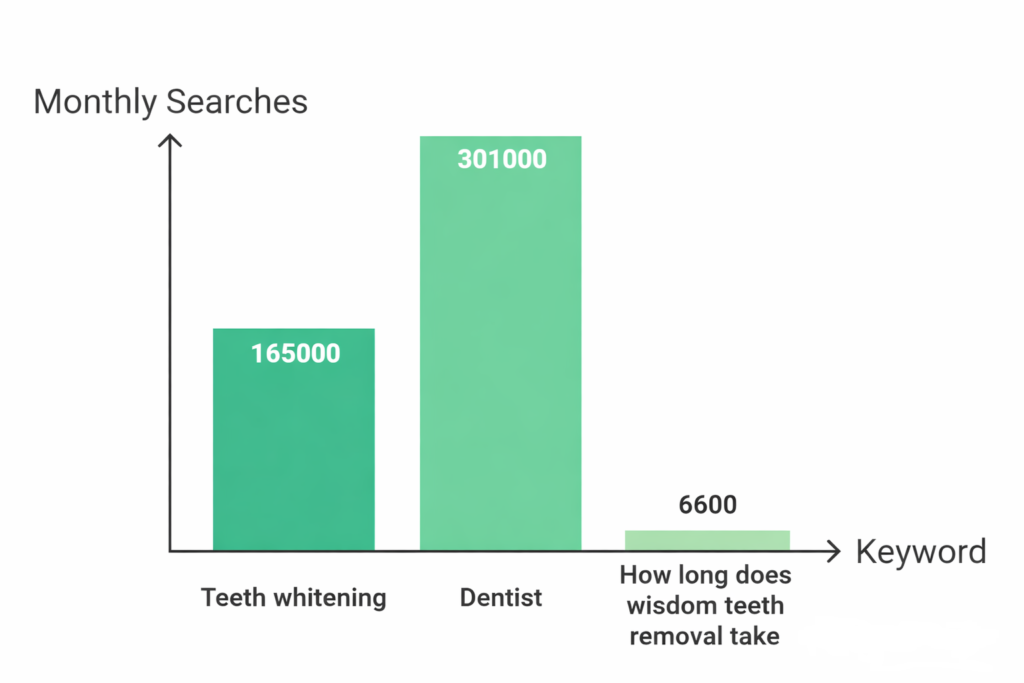
Vanity keywords look impressive in a report but deliver almost no patients. Teeth whitening gets 165,000 monthly searches with a KD of 84, but the vast majority of those searchers want at-home whitening kits. They are shopping on Amazon, not looking for a dental appointment. The term professional teeth whitening near me is a fraction of the volume but far more likely to result in a booking.
Similarly, dentist (301,000 monthly searches, KD 58) is too broad. The search intent is scattered across definitions, career information (“how much do dentists make” gets 9,900 searches), and local provider searches. Your energy is better spent on [specialty] dentist [city] variations.
Pure informational keywords drive traffic but rarely produce patients on their own. Keywords like how long does wisdom teeth removal take (6,600 monthly searches, KD 2) are easy to rank for, but the searcher already has an appointment booked.
These keywords have a role in a content strategy (they build topical authority and internal link equity), but they should never be your priority when service keywords with real conversion potential remain uncovered.
How Should You Actually Use These Keywords on Your Website?
Every category of dental SEO keywords maps to a specific page type on your website. Here is the decision framework:
| Keyword Type | Best Page Type | Priority |
|---|---|---|
| Service + city | Dedicated service page | Highest |
| “Near me” | GBP optimization + service pages | Highest |
| Review / trust | GBP reviews + local directories | High |
| Emergency | Dedicated emergency page | High |
| Symptom / condition | Blog post → links to service page | Medium |
| Cost / insurance | Pricing page or FAQ section | Medium |
| Broad / vanity | Skip or deprioritize | Low |
One Dedicated Page Per High-Value Service
Every revenue-generating service your practice offers should have its own page. A single “Services” page listing everything you do will never rank for any specific dental SEO keywords because Google cannot determine what the page is primarily about.
Your dental implants page targets “dental implants [city].” Your veneers page targets “veneers [city].” Each page should include: a clear description of the service, pricing information, or at a minimum price range, answers to common patient questions, and patient reviews specific to that service.
If your current agency has you running on a single services page, that is a red flag worth investigating in a dental website SEO audit.
Blog Posts for Symptom and Question Keywords
Symptom keywords and patient questions belong in blog posts. The post answers the patient’s question, demonstrates your expertise, and links to the relevant service page. Example: a patient searches “what to do if you crack a tooth,” finds your blog post, reads their options (crown, veneer, bonding), and clicks through to your dental crowns service page.
Google Business Profile for “Near Me” and Review Keywords
For any keyword that includes “near me,” a city name, or trust signals like “best” or “top rated,” your Google Business Profile performance is as important as your website. Complete category selections, a steady stream of recent patient reviews, and regular GBP posts are the three factors that matter most. Your local SEO strategy should treat GBP as a core channel.
How Can You Research Keywords for Your Specific Market?
The dental SEO keywords in this article reflect national US averages. Your actual keyword landscape depends on your city, your competition, and the services you offer. Here is how to start building your own keyword list:
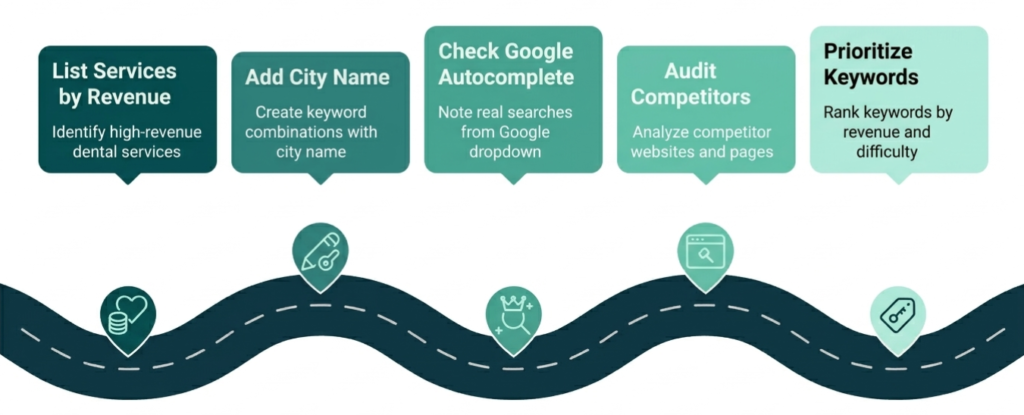
Step 1: List your services by revenue. Implants, orthodontics, cosmetic procedures, and full-arch restorations typically sit at the top.
Step 2: Add your city name. Create combinations: “dental implants [city],” “invisalign [city],” “emergency dentist [city].” These are your primary keyword targets.
Step 3: Check Google Autocomplete and “People Also Ask.” Type each combination into Google and note what appears in the dropdown and the question boxes. These are real searches patients in your area are making.
Step 4: Audit your competitors. Search your top 3 service + city combinations. Which practices appear? What pages do they have? If a competitor has a dedicated “dental implants in [city]” page and you have a generic services page, that is a gap you can close.
Step 5: Prioritize by revenue and difficulty. Use Google Search Console (if your site is live) to see which queries bring impressions, or tools like Semrush or Ahrefs for a complete picture of volume, difficulty, and competitor data.
This process gives you a starting list. A professional keyword audit goes deeper: competitor gap analysis, Local Pack rankings, keyword cannibalization checks, and a prioritized 90-day action plan. We offer this as part of our dental SEO services.
If your keyword research surfaces opportunities you don’t have the time or in-house expertise to act on, our guide on dental SEO companies worth considering covers the criteria to use when evaluating any provider before you commit.
How Will AI Search Change Dental Keyword Strategy?
Google AI Overviews, ChatGPT search, and Perplexity are already changing how patients find dental information, and the practices with structured, specific content are the ones getting cited. The content that AI systems pull into their answers shares specific traits: it targets well-defined dental SEO keywords, answers a clear question in the first sentence, uses structured data (tables, numbers, categories), and comes from a source with demonstrated expertise.
For dental practices, this means the same keyword strategy that works for traditional Google rankings also positions you well for AI search. Service pages with clear pricing, FAQ sections that answer real questions, and blog posts built around specific patient queries are exactly what AI systems reference when generating answers. The practices that will struggle are those relying on thin, generic content that repeats the keyword without providing substance.
We will cover AI search optimization for dental practices in a dedicated article. The principle is simple: create content that would be useful even if search engines did not exist, and both Google and AI systems will reward it.
Frequently Asked Questions
How long does it take to rank for a dental SEO keyword? For low-difficulty keywords (KD under 10), a well-optimized page can reach the first page within 60 to 90 days. Higher-difficulty keywords like “dental implants near me” (KD 50) typically require 6 to 12 months of consistent SEO work, including backlink building and content authority.
Should a dental practice target national or local keywords? Local keywords almost always. A dental practice in Austin gains nothing from ranking nationally for “dental implants.” The patients who will actually book are searching “dental implants Austin” or “dental implants near me” while physically located in your service area.
How many dental SEO keywords should a single page target? One primary keyword and two to three closely related variations. Your “dental implants [city]” page can also target “implant dentist [city]” and “best dental implants [city]” because Google understands these as the same topic. Trying to target “dental implants” and “teeth whitening” on the same page means you will rank for neither.
Are dental SEO keywords still relevant with AI search? Yes. AI tools like Google AI Overviews and ChatGPT pull their answers from web pages that rank well for specific queries. Dental SEO keywords remain the foundation that makes your content findable by both traditional search and AI systems.
Start With Your Highest-Value Dental SEO Keywords
Your next step: list your three highest-revenue services, add your city name to each, and check whether you have a dedicated, optimized page for each combination. If you do not, that is your first priority. Everything else, the blog posts, the GBP optimization, the broader content strategy, builds on that foundation.
If you want to see exactly which dental SEO keywords your competitors rank for in your local market and where the gaps are, request a free keyword audit. We will show you the specific opportunities in your area using the same Semrush data we used throughout this article.
About the Author

Copywriter and SEO specialist with 18 years of experience in healthcare and B2B marketing, including work with global pharmaceutical clients like Sanofi. He focuses on dental SEO strategy, combining healthcare content expertise with data-driven local search analysis.
Get a free dental SEO keywords audit