Dental Marketing Plan: 2026 Framework and Template
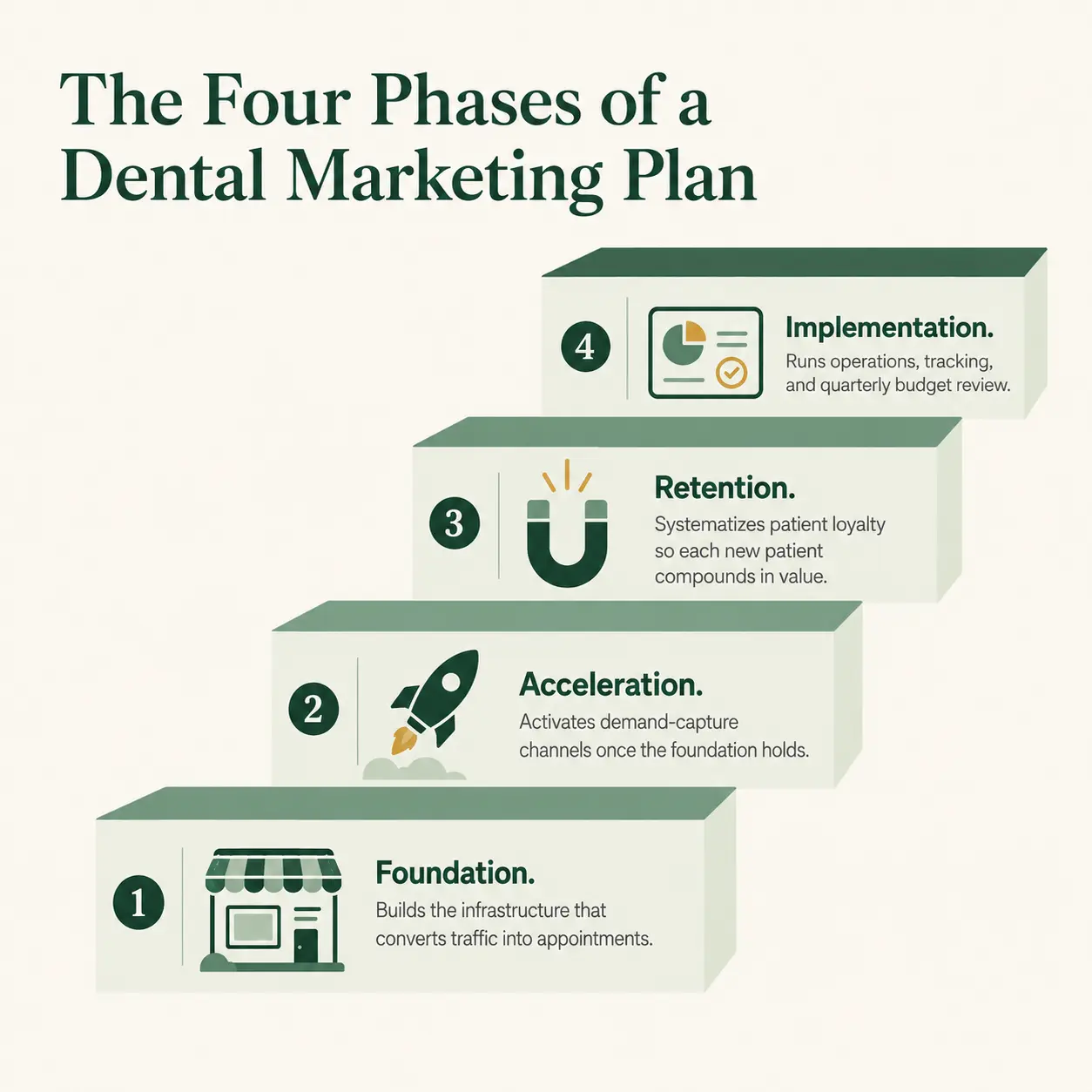
Key Takeaway: A working dental marketing plan has three sequential phases and one layer that runs through all of them. Foundation builds the digital infrastructure that converts traffic into appointments. Acceleration activates demand-capture channels once that foundation holds. Retention systematizes patient loyalty so each new patient compounds in value. Implementation is not a fourth phase but the operating layer underneath: who owns the work, what gets tracked, and how budget moves. In the practice websites we have audited, the same failure repeats: budget flows to acquisition while the website, the Google Business Profile, and the review system stay untouched.
In 90 Seconds: The Quick Answer
If you only have a minute, here’s the short version:
- The Foundation problem. Most dental marketing plans fail not because of bad channel choices but because they spend on Google Ads or social media before the website, Google Business Profile, and review system can convert that traffic. Skip Foundation and every acquisition dollar lands on infrastructure that bounces.
- The number that should drive 2026 planning. Clicks in the highest-intent dental categories are expensive. In our August 2026 keyword measurement, “dental implants near me” carried a cost per click of $16.68. That is what a practice pays for one visitor, before anyone books, shows up, or accepts a treatment plan. Organic visibility on the same term costs nothing per click once earned.
- The structure. Three phases (Foundation, Acceleration, Retention) plus an operating layer (Implementation) that runs from day one rather than arriving at the end. The section below gives the seven-part plan document itself, and a worked example carries a single practice through it.
- Walk-away signals. A plan that starts with channel selection rather than a keyword and digital-presence audit, plans for Google search but not AI search, ignores the seasonal shape of dental demand, or treats retention as a customer-service afterthought is missing the levers that compound.
- How to use this guide. Start with the plan skeleton. Fill it in against your own numbers. The five-step action plan turns the filled-in document into a six-month sequence.
Why Do Most Dental Marketing Plans Fail Before They Start?
A dental marketing plan fails most often at the foundation phase. Practices allocate budget to Google Ads or social media before their website, Google Business Profile, and review systems can convert traffic into appointments. A successful 2026 plan starts with two diagnostic steps: a keyword audit and a digital-presence audit. Only then does channel selection make sense, and AI search visibility belongs in the foundation from day one.
A 2026 plan also needs to account for two search ecosystems. Traditional Google search still drives most appointment-booking traffic, but AI-driven search through AI Overviews, ChatGPT, and Perplexity has become the discovery layer for a growing share of patients. A plan written for only one ecosystem misses patients arriving through the other.
A note on the numbers in this guide. Dental marketing is an unusually badly sourced field. Most of the statistics circulating in it originate on agency blogs, get quoted by other agency blogs, and acquire authority through repetition rather than evidence. Where we cite a figure below, we name the study and the publication it appeared in. Where a commonly repeated number turned out to be untraceable, we left it out and said so.
This dental marketing plan guide covers the three phases where most practice growth comes from, plus the operating layer that keeps them running. Adjacent topics (brand experience design beyond positioning, community partnerships, PR and earned media, telehealth marketing) sit outside this framework. Our complete dental marketing guide covers the full channel-by-channel universe.
What Should a Dental Marketing Plan Actually Contain?
A dental marketing plan is a seven-part document. Most practices never write one because the advice they find explains marketing rather than giving them the pages to fill in. Here is the skeleton. Each section is two or three questions with numbers attached, and a complete plan fits on four or five pages.
1. Where you are now. The baseline you will measure everything against.
- What does your website currently rank for, and how many organic visitors does it bring per month?
- How complete is your Google Business Profile, how many reviews do you have, and how many arrived in the last 90 days?
- How many new patients did you see each month for the last twelve months, and where did they come from?
2. Who you are for. The positioning that every channel decision follows from.
- Which two or three services do you want more of, ranked by profit rather than volume?
- Which patients are those services for, described specifically enough that you could write an ad to them?
- What is the one sentence that answers “why this practice over the three others nearby”?
3. What you want. Two targets, not one.
- A realistic new-patient target per month for the next twelve months.
- A stretch target you would be pleased to hit.
- The maximum you can pay to acquire a patient and still be profitable on your average case.
4. What the market looks like. The part almost every plan skips.
- What do patients in your area actually search for, in volume order, for the services from section 2?
- Which of those terms are realistically winnable, and which are locked up by established competitors?
- Which practices already rank in your local pack, and what do they have that you do not?
5. What you will do. The three phases, sequenced.
- Foundation: what has to be fixed or built before any acquisition spend makes sense.
- Acceleration: which channels you will activate, in what order, and on what trigger.
- Retention: which systems keep the patients you already have.
6. What it costs and where it goes. A monthly number split three ways.
- Total monthly budget, derived from your patient target and your acquisition cost.
- The split across Foundation, Acceleration, and Retention.
- What each line is expected to return, so an underperforming line is visible.
7. How you will know. The operating layer.
- Who owns each task, and how many hours per week is that.
- Which seven numbers you review monthly.
- The threshold at which you move budget away from a channel.
A plan that answers those twenty-odd questions is more useful than any template, because the answers are yours. The rest of this guide works through what belongs in each section.
What Goes Into the Foundation Phase of a Dental Marketing Plan?
The Foundation phase of a dental marketing plan establishes the digital infrastructure that converts traffic into appointments. Without it, every acquisition dollar lands on traffic that bounces. Foundation also extends beyond SEO and GBP into the conversion-handling work that surrounds them: call-answering capacity, online-booking flow, and mobile-friendly forms.
We audited an orthodontic practice in North Dakota that illustrates the pattern exactly. The site had nine schema types implemented, paid search running, and a marketing automation platform installed. The technical work was better than most practices we review. The blog had not been updated since May of the previous year, and the automation platform had no lead magnet feeding it. Money was moving through the acquisition layer while the two things that make acquisition pay off, fresh content and a reason for a visitor to identify themselves, sat idle. That is the Foundation gap in its most expensive form: it looks like a practice doing marketing.
Foundation work has five components.
Website and SEO baseline. A dental website needs three things to convert traffic: mobile responsiveness, page-speed under 3 seconds, and structured data so search engines and AI tools understand what services you offer. Local SEO (geographic targeting, NAP consistency for Name-Address-Phone, citation-building) sits inside this same Foundation layer. Our complete dental SEO guide walks through the four pillars (on-page, technical, local, off-page) and the audit checklist that supports them.
In 2026, “SEO-ready” also means AI-ready. Structured data, content depth, and clear service descriptions determine whether AI Overviews, ChatGPT, and Perplexity can cite your practice when patients ask AI assistants for dental recommendations. We re-measured our 153-keyword agency-side keyword set in August 2026: AI Overview now appears on 84% of those keywords, covering 81.7% of their combined search volume, up from 50% of keywords at our previous measurement. Five out of six relevant search-result pages now open with an AI-generated answer above the organic listings.
Dental content also falls under Google’s Your Money or Your Life classification, which raises the bar on expertise and trust signals. The Search Quality Rater Guidelines set out what that means in practice: named authors with credentials, clinician review on health claims, and citations to authoritative sources. A dental marketing plan that skips those signals will underperform regardless of channel budget.
Google Business Profile and Local Service Ads. GBP optimization remains the highest-leverage Foundation work for most local practices: complete categories, current photos, weekly posts, seeded Q&A. Google’s Local Business structured data documentation covers the markup that lets Google verify and surface this information across Search and Maps. Our local SEO for dentists service page covers the full GBP framework. In 2025-2026, Google’s Local Service Ads format has emerged as a separate paid-search channel, verified, location-pinned, and pay-per-lead rather than pay-per-click.
Review pipeline. A working system has three parts: a request mechanism (post-appointment text or email with direct link), a target volume and rating threshold, and a response policy for every review. BrightLocal’s Local Consumer Review Survey tracks how patients actually use reviews when choosing a provider.
Keyword research as plan input. A marketing plan for a dental clinic that starts without keyword research is guessing at what local patients actually search for. The 110,000-keyword dental search corpus we work from shows that service-keyword volume and cost-per-click vary by an order of magnitude across procedure categories, geography, and search intent. This component is worth its own section, below.
Brand positioning and unique value proposition. Your UVP is the one-sentence answer to a prospective patient asking, “Why this practice over the three others nearby?” Most practices default to generic claims (“caring team,” “modern technology”) that every competitor also claims. A useful UVP names a specific patient experience or specialty advantage: “Same-day implant consultations with 3D imaging,” “In-house orthodontics for the whole family,” “Sedation dentistry for anxious patients.” The UVP becomes the through-line for every channel that follows.
How Does Keyword Data Change the Plan?
Section 4 of the plan skeleton is the one most practices skip, and it is the one that changes every decision after it. Guessing at demand usually means chasing the largest term in the category, which is also the one the practice is least likely to win.
The gap between categories is wider than most practices expect, and it usually runs in the practice’s favour. In our August 2026 measurement, the phrase local seo for orthodontists carried a keyword difficulty of 0, while dental seo services sat at 29 with roughly six times the volume. The same pattern holds on the patient side: specialty terms and service-plus-location combinations are consistently easier to win than the broad head terms, and they convert better because the searcher has already decided what they need.
Three questions turn keyword data into plan decisions:
Which of your services has demand you are not capturing? Pull the search volume for each service you offer, in your metro. The answer frequently contradicts the practice’s assumption about which service line to promote.
Which of those terms can you realistically win in twelve months? Difficulty scores and the current top ten tell you this. A term where the top results are national directories and DSO sites is a different proposition from one where three local practices with thin pages are ranking.
What does that imply for content order? Write for the winnable, high-intent terms first. The head terms come later, once the site has the internal linking and authority to support them.
A practice that starts from data finds those gaps. A practice that starts from channel selection never sees them. Our dental keyword research guide covers the method, and our SEO for orthodontists page covers the specialty case in detail.
Which Channels Acquire New Patients Once the Foundation Holds?
Acceleration is the second phase of a dental marketing plan, and it activates demand-capture channels once converting infrastructure is in place. Practices that skip Foundation pay the full paid-search price for every patient indefinitely, because nothing they build compounds underneath it.
Google Ads and the click-cost arithmetic. Paid search captures high-intent service keywords (implant, emergency, cosmetic) within days, while SEO compounds over months. The cost difference is easiest to see if you work from your own click prices rather than from an industry average.
In our August 2026 US keyword measurement, “dental implants near me” carried a cost per click of $16.68 and “invisalign near me” $9.67. Those are the prices for a single visitor. To convert a click price into a patient acquisition cost, multiply by your own funnel: how many clicks become consultation requests, how many requests become booked consultations, how many booked consultations show up, and how many accept treatment. A practice that loses half its inquiries at the front desk pays double per patient for exactly the same ad spend, which is why the operating layer treats call handling as a marketing metric rather than an office one.
Published estimates of dental patient acquisition cost sit in a wide band, roughly $150 to $500, and vary with procedure mix and market. Rather than adopting anyone’s average, calculate your own from ad spend divided by patients who actually accepted treatment. Our PPC for dentists guide covers the channel head-to-head against SEO in operational detail.
AI-driven patient research. A growing share of patients researches dentists through ChatGPT, Claude, and Perplexity before they ever load a search results page. The industry calls this Generative Engine Optimization (GEO): a discipline focused on being citable in AI answers, separate from traditional SEO ranking. The scale is already measurable on the agency side of the market, where 82% of search volume returns an AI answer above the organic results. Patient-side queries lag that number, but the direction is the same.
Short-form video. Younger patient demographics discover practices through TikTok, Instagram Reels, and YouTube Shorts. A 2026 plan that ignores this channel for cosmetic, orthodontic, or family-friendly practices leaves a generational segment to competitors.
Social media, with honest framing. Social media rarely closes a dental appointment on its own. In the practice audits we run, the accounts that look healthiest by follower count are frequently the ones with the weakest booking data behind them, because attention and intent are different things. Budget social as a brand-and-trust layer that supports the channels which capture demand. Our dental social media marketing guide covers the channel-by-channel approach in depth.
Direct mail. New-homeowner lists still produce reasonable response rates for general dentistry in some markets, particularly suburban geographies with strong family-household density.
Referral programs and response speed. Patient referrals remain the highest-converting channel for established practices. The 2026 layer on top is response automation: when a new lead calls or fills a form, modern tools drop response time from hours to seconds. Lead-response research across industries has consistently found that speed changes qualification odds by an order of magnitude, and dental inquiries behave the same way, because a patient with a problem calls the next practice on the list rather than waiting.
Acceleration channels do not work without Foundation. Ad spend that lands on a page which cannot convert is spend with no return path.
How Do Retention Systems Compound Patient Value?
The Retention phase of a dental marketing plan systematizes the conversion of one-time appointments into long-term patient relationships. Most practices file retention under customer service. It belongs in the marketing system, where it can be measured, budgeted, and improved on a schedule.
The best-documented number in this area comes from Levin Group’s 30-year study of top-performing practices, published in Dental Economics: the average practice loses 12-15% of its patients each year, while the top 10% lose only 7-8%. That gap is the entire argument. A practice holding on to an extra seven percentage points of its base annually is, within a few years, running a structurally larger business on the same marketing budget.
Published estimates of dental patient lifetime value range from roughly $3,000 to $12,000 depending on practice type, procedure mix, and how long the source assumes a patient stays. The spread is wide enough that you should calculate your own rather than adopt a benchmark: average annual production per active patient, multiplied by your average years of retention. Whatever number that produces, compare it to what you pay to acquire a patient. In almost every practice we have looked at, the retention side wins by a wide margin, and it is the side receiving no budget.
Three components carry most of the Retention weight.
Email marketing. Recall reminders, reactivation campaigns for lapsed patients, and seasonal education each play a role. HIPAA-compliant practices keep clinical detail out of marketing email and route anything patient-specific through secure channels. A common reactivation tactic that performs well: a single-CTA SMS or email to patients 6+ months inactive, timed to align with insurance benefit-renewal cycles. The simpler the ask, the higher the response. Our dental email marketing guide covers HIPAA-aware cadence and campaign templates.
Dental membership plans. In-house membership plans reduce dependence on insurance reimbursement, build a predictable revenue floor, and meaningfully improve year-over-year retention. They function as both a retention tool and an acquisition incentive for uninsured patients.
SMS and text-message reminders. Appointment confirmation by text reduces no-shows materially. Modern systems also handle reactivation, recall, and birthday outreach with low operational cost.
Who Runs the Plan, and What Should They Track?
Implementation is the operating layer of a dental marketing plan rather than its final phase. It starts on day one alongside Foundation, because a plan with no owner and no measurement produces no evidence about what worked. Three components carry it: internal resource allocation, tracking infrastructure, and quarterly budget review.
Internal resources. Marketing operations in a small practice usually land on the office manager, on top of a full existing role. Before assigning it that way, price the hours: someone has to own GBP posting, review requests, content scheduling, and monthly reporting, and those tasks disappear the moment the front desk gets busy. Practices without that capacity hire a dedicated marketing role at 5+ practitioners or partner with a specialized agency for channels where in-house expertise is unrealistic. Our guide to choosing a dental SEO company walks through the criteria that matter.
Tracking infrastructure and first-party measurement. Call tracking with unique numbers per channel, UTM parameters on every link, conversion goals in GA4, and a centralized dashboard make attribution defensible.
The 2026 tracking picture is messier than the industry expected. Google abandoned its plan to remove third-party cookies from Chrome in 2024 and moved to a user-choice model instead, while Safari and Firefox have blocked them by default for years. The result is uneven rather than uniform: tracking works for some visitors and silently fails for others, and the failure rate depends on your traffic mix. That unevenness, together with iOS privacy changes, is what makes first-party data collection and server-side tracking worth building. The argument for it no longer rests on any single deprecation date.
The connection most practices skip is offline conversion tracking. Dental practice management systems like Dentrix or Open Dental can be connected to Google Ads through Enhanced Conversions or offline conversion uploads, so the ad platform learns which clicks become real, paying patients rather than only which clicks become form fills.
Tracking also has to account for the front-desk gap that swallows marketing spend. Peerlogic tracked 4,280 inbound calls across 26 dental practices and found that 38% went unanswered during business hours. Of the calls that were answered, only about a quarter of new-patient inquiries became a booked appointment. Industry figures put the share of new patients who leave a voicemail at roughly 14%; the rest call the next practice on their list. Call-handling capacity is as critical as the marketing spend that generated the call, and it is measurable from your phone system this week.
Budget management. Quarterly review, channel reallocation, and a documented decision threshold (move budget when a channel underperforms by X% for Y consecutive months) keep the plan from drifting.
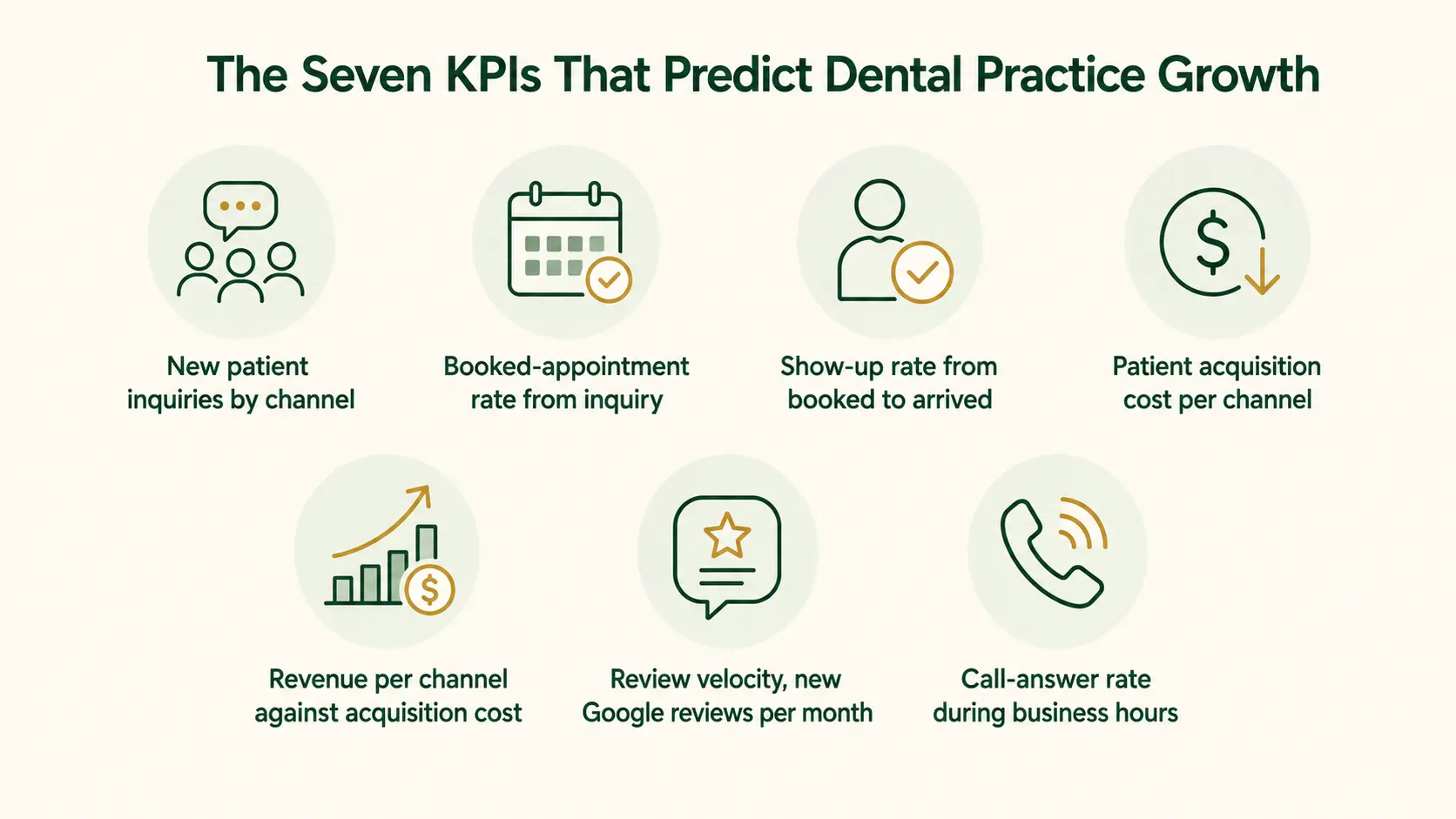
The KPIs that actually predict practice growth, distinguished from the vanity metrics that occupy most dashboards, sit in a fairly short list:
- New patient inquiries (form fills plus tracked calls per channel)
- Booked-appointment rate from inquiry
- Show-up rate (booked-to-arrived)
- Patient acquisition cost per channel
- Revenue per channel against acquisition cost
- Review velocity (new Google reviews per month)
- Call-answer rate during business hours
Impressions, follower counts, and click-through rates have their place, but they belong below the predictive layer in any monthly review.
How Does Seasonality Change a Dental Marketing Plan?
Dental demand is not flat across twelve months, and a plan that spends evenly across them wastes money in the quiet periods and under-buys in the busy ones. Four seasonal patterns are worth building into the calendar.
The December benefit expiry. Patients with employer dental insurance lose unused annual benefits at year end. That deadline concentrates elective and restorative treatment acceptance into the final weeks of the year more sharply than any other point in the calendar. The marketing work that captures it happens in October and November, aimed at existing patients with open treatment plans, not at new patients.
The January reset. New benefit year, new deductibles, and a patient population making health resolutions. This is the strongest window of the year for reactivating lapsed patients, because the financial objection they had in October has just reset.
Summer and the school calendar. Pediatric visits, orthodontic consultations, and wisdom teeth extractions cluster around school breaks, because families schedule around them. Orthodontic practices in particular see consultation demand shift months before the treatment itself.
Cosmetic peaks. Whitening and cosmetic consultations rise ahead of wedding season in late spring and again in the weeks before the winter holidays. These are short, predictable windows where paid search is worth its price because the intent spike is real and brief.
Two planning implications follow. First, budget by quarter rather than by month, and let the quarterly split follow your own production history rather than these general patterns. Pull twelve or twenty-four months of production data by procedure category before setting the calendar; the shape of your market may differ from the national one.
Second, content has to lead demand by a season. An article about maximizing dental benefits before year end published in December is late. Published in September, it has time to rank before the demand arrives.
What Does a Six-Month Dental Marketing Action Plan Look Like?
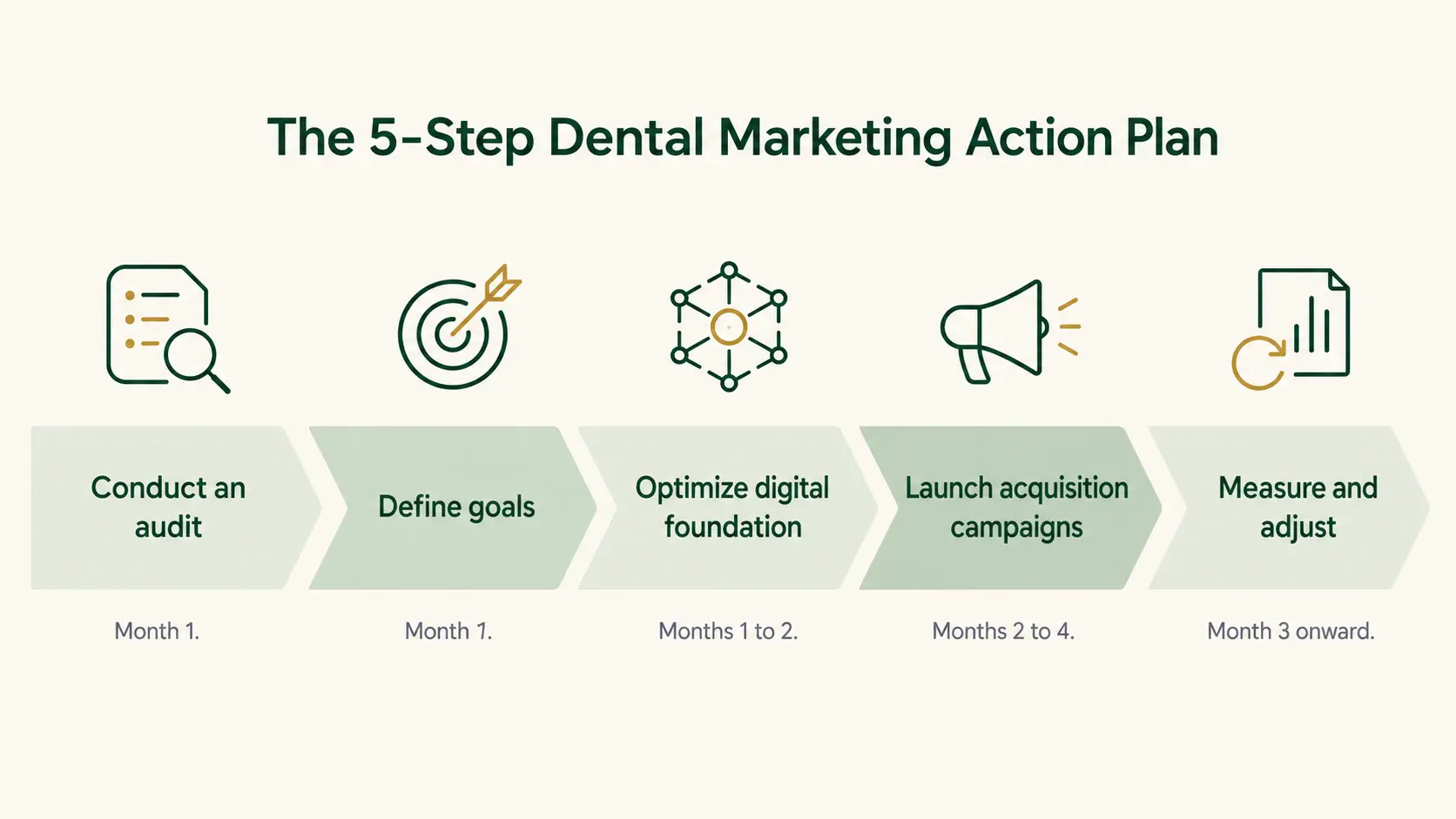
The three phases of a dental marketing plan are not linear in calendar time. Foundation and Acceleration usually overlap, and the operating layer runs throughout. The 5-step action plan organizes the work into a runnable sequence.
| Step | What you do | Timing | Output |
|---|---|---|---|
| 1. Conduct an audit | Website audit, keyword audit, GBP review | Month 1 | Baseline report |
| 2. Define realistic and stretch goals | Dual-scenario patient-number targets | Month 1 | Goal document |
| 3. Optimize digital foundation | Website, GBP, review pipeline, UVP | Months 1-2 | Converting infrastructure |
| 4. Launch acquisition campaigns | Paid search, content, referral systems | Months 2-4 | Active demand-capture |
| 5. Measure and adjust | Quarterly KPI review, budget reallocation | Month 3+ | Iterative optimization |
Each step of the dental marketing plan has concrete tasks underneath. Most plans fail not because the structure is wrong but because the tasks were never written down.
Step 1 (Audit) tasks:
- Run a website audit against the checklist in our dental website audit guide
- Pull a keyword map for your local market following our dental SEO keywords guide
- Review GBP categories, photos, posting cadence, and review-pipeline state
- Pull twelve months of production by procedure category to establish your seasonal shape
Step 2 (Goals) tasks:
- State two new-patient targets for 12 months (realistic and stretch)
- Translate the realistic target into monthly new-patient acquisition cost ceilings
- Document the assumptions behind both targets so quarterly reviews can revisit them
Step 3 (Optimize) tasks:
- Fix the top 5 conversion blockers from the website audit
- Complete GBP optimization and post a weekly schedule
- Stand up the review-request system and define a 30-day target
- Write the UVP and audit every channel to confirm it shows up
Step 4 (Launch) tasks:
- Activate Google Ads on the 3-5 highest-intent service keywords
- Publish the first 4 content pieces aligned with the keyword map
- Roll out the referral incentive structure to existing patients
- Connect call tracking and configure first-party conversion events
Step 5 (Measure) tasks:
- Review KPIs monthly, reallocate budget quarterly
- Compare actuals against both realistic and stretch targets
- Document one channel learning per quarter, even when results match expectations
Step 1 deserves a longer note. A useful audit has three components. The website audit checks whether your site converts traffic. The keyword audit identifies what your local market actually searches for. The GBP review covers categories, photos, posting cadence, and review pipeline state. Without the audit, every channel decision that follows it is a guess.
Step 2 also deserves a longer note. The most common goal-setting failure is the single-goal trap: practices set one stretch goal, budget around it, and call the result a failure when reality lands lower. The fix is to state two targets. A realistic 12-month target and a stretch target. Budget around the realistic one. Execute toward the stretch one.
How Much Should a Dental Practice Budget for Marketing?
There is no primary source for dental marketing budgets, and the published guidance disagrees with itself. We compared what the commonly cited sources actually recommend for the same practice:
| Source type | Established practice | New or growing practice |
|---|---|---|
| Practice management consultants | 3-6% of revenue | 8-12% |
| Dental technology vendors | 3-5% | 6-10% |
| Marketing agencies | 5-10% | 10-15% |
| Trade press practitioner guidance | up to 15% | 20-30% |
A range from 3% to 15% for the same question is not a benchmark. It is a signal that nobody has measured this properly across a representative sample of practices.
What the sources do agree on is direction. Established practices spend a smaller share of revenue than new ones, and the gap is roughly double. Use that shape to sanity-check a number you derive from your own economics, rather than adopting a percentage and working backward from it.
| Practice size | Monthly budget as a starting point | Suggested split (Foundation / Acceleration / Retention) | Expected timeline to ROI |
|---|---|---|---|
| Solo, established | $1,500-3,000 | 40 / 50 / 10 | 6-9 months |
| Group (2-5), established | $3,000-6,000 | 30 / 55 / 15 | 4-6 months |
| New practice, year 1-2 | $6,000-15,000+ | 50 / 40 / 10 | 9-12 months |
| Small DSO (5-20) | $10,000-25,000+ | 25 / 55 / 20 | 3-6 months |
Where the budget goes is one question. Where new patients actually come from is another, and here the honest answer is that no reliable public dataset exists. Attribution figures circulating in dental marketing typically originate from single agencies reporting on their own client base.
What we can describe is the lifecycle pattern, which shows up consistently in practice audits and follows from how the channels work rather than from any survey. A new practice has no referral flywheel, no review volume, and no local search authority, so it buys visibility. An established practice has all three, so referrals and organic search carry proportionally more of the load and paid search becomes optional rather than structural.
| Channel | New practice (year 1-2) | Established practice (year 3+) |
|---|---|---|
| Patient referrals | Minimal | Largest single share |
| Local SEO and Google Business Profile | Substantial from month one | Substantial and stable |
| Organic search (content and service pages) | Small, growing | Meaningful |
| Reviews and reputation signals | Small, growing | Meaningful |
| Paid search (Google Ads) | Largest single share | Supplementary |
| Email and SMS retention | Minimal | Meaningful |
| Social media | Minimal | Minimal |
| Direct mail and community outreach | Situational | Situational |
Treat this as a shape to test, not a set of percentages to plan against. Your call tracking and CRM will produce your real distribution within two quarters, and that distribution is the only one that should move budget.
A Worked Example: One Practice Through the Whole Plan
Abstractions are easy to agree with and hard to act on. Here is the framework applied to a composite general practice, with every number carried through.
The practice. Suburban general dentistry, one dentist and one hygienist, three operatories, $900,000 in annual production. Currently seeing 14 new patients a month, mostly from word of mouth. A website built four years ago, 31 Google reviews with the most recent one eight months old, and no marketing spend beyond a directory listing.
Section 3, the target. The owner wants 25 new patients a month. Average production per new patient in the first year is $850. Twenty-five patients a month at $850 is $255,000 in incremental annual production. The owner decides the maximum acceptable acquisition cost is $250 per patient, which caps the acquisition side of the budget at $6,250 a month if every patient were bought. Nobody buys every patient, which is the point of the split.
Section 6, the budget. At $900,000 in production, a 4% allocation is $36,000 a year, or $3,000 a month. This is an established practice with a broken foundation, so the split runs Foundation-heavy in the first two quarters: $1,500 Foundation, $1,200 Acceleration, $300 Retention. From month seven, as the foundation work converts from build to maintenance, the split moves toward $900 / $1,800 / $300.
Section 1 and 4, what the audit found. The site ranks for the practice name and nothing else. The GBP has one category, no service list, and no posts. Reviews are stale. Call tracking does not exist, so the 14 monthly new patients have no attribution at all. On the keyword side, “dental implants [city]” is dominated by two DSO sites, but “same day crowns [city]” and “emergency dentist [city]” both have weak local results and no practice targeting them with a dedicated page.
Section 5, what happens in six months. Months one and two: GBP rebuilt, review request system live with a target of four per month, three conversion blockers fixed on the site, call tracking installed. Months two through four: two service pages published for the winnable terms found in the audit, Google Ads running on emergency and same-day crown terms only, referral cards handed to every patient who accepts treatment. Months three onward: monthly KPI review.
Where the reverse funnel lands. Of the 25-patient target, the plan assigns 10 to Google Business Profile, 5 to organic content, 6 to referrals, and 4 to paid search. Work each line back through two conversion steps rather than one, because an inquiry is not yet a patient. Assuming 70% of inquiries book and show, the GBP line needs roughly 15 calls to produce 10 patients, and at a 2-4% conversion of profile views to calls that means 375 to 750 monthly profile views. The content line needs about 8 form submissions to produce 5 patients, and at 1-2% of visitors converting that means 400 to 800 monthly visits. Paid search at four patients and $250 each is $1,000 a month, which fits inside the Acceleration allocation with room for testing. The 70% figure is an assumption until the practice measures its own; that is exactly the kind of number the operating layer exists to produce.
What makes or breaks it. The single largest risk in this plan is not the budget. It is that the practice answers 62% of its calls, so a third of everything the plan generates never reaches a human. Fixing that before month three costs nothing in marketing spend and changes every number above.
Substitute your own figures and the same seven sections produce a plan you can defend to yourself in a quarterly review.
A note on what compounds and what does not: Dental Rank Lab focuses on the three channels where investment compounds month over month: SEO, Google Business Profile optimization, and content. Each month of work in these increases the return on the next. For paid search execution, email and SMS systems, referral programs, and direct mail, other specialists or in-house resources fit the operational rhythm better. Our free SEO audit shows which of the compounding channels would deliver the highest return for your local market.
Frequently Asked Questions
What should a dental marketing plan include?
Seven sections: where you are now (audit baseline), who you are for (services and positioning), what you want (realistic and stretch patient targets plus a maximum acquisition cost), what the market looks like (keyword demand and local competition), what you will do (the three phases, sequenced), what it costs and where it goes (monthly budget split across Foundation, Acceleration, and Retention), and how you will know (owners, KPIs, and the threshold for moving budget). A complete plan fits on four or five pages.
How long does a dental marketing plan take to show results?
Foundation changes (website optimization, GBP updates, review pipeline) show traction within 60-90 days. Acceleration channels show measurable lift within 30 days but need 6-12 weeks of optimization to stabilize. Retention systems compound over 6-12 months. A reasonable expectation: 90 days for the first measurable lift, 6 months for clear ROI, and 12 months for the plan’s full effect on monthly new-patient numbers.
What if I don’t have a marketing person on staff?
Most small and mid-size dental practices do not. Three common paths work: the office manager takes marketing operations as a defined part of their role with hours protected for it, the practice hires a dedicated marketing role at 5+ practitioners or DSO scale, or the practice partners with a specialized agency for channels where in-house expertise is unrealistic. The failure mode in the first option is predictable: marketing tasks are the first thing dropped when the schedule gets busy. Our guide to choosing a dental SEO company walks through the evaluation criteria.
How much should a dental practice spend on marketing?
Published guidance ranges from 3% to 15% of revenue for the same question, which tells you the percentage approach has limits. A more useful method: multiply your new-patient target by what you currently pay to acquire a patient, then check that number against what those patients produce. The budget table earlier in this article gives monthly ranges by practice size as a starting point for that calculation.
Does dental marketing need to change with the seasons?
Yes, in two ways. Budget should follow demand rather than the calendar, which for most practices means weighting the fourth quarter toward existing patients with unused insurance benefits and the first quarter toward reactivating lapsed ones. Content has to lead demand by roughly a season, because an article published the month the demand arrives has no time to rank. Pull twelve months of your own production by procedure category before assuming the national pattern applies to your market.
What’s the difference between a marketing plan and a marketing strategy?
A dental marketing plan answers “what will we do, when, and with what budget.” It is the document this guide helps you build. A marketing strategy sits one level up and answers “which patient segments are we serving, what is our positioning, and what competitive advantage are we building.” A plan implements a strategy. For execution-side detail, our dental marketing strategies guide covers the operational layer.
How do you track dental marketing ROI?
Marketing ROI for a dental practice has three measurement layers. First, channel-level inputs: call tracking with unique numbers per channel, UTM parameters on every link, and conversion events in GA4. Second, the connection between online activity and offline revenue: most practices skip this step, but Dentrix or Open Dental can be connected to Google Ads through Enhanced Conversions, so the platform learns which clicks become paying patients. Third, the quarterly review that compares acquisition cost per channel against revenue per channel and reallocates budget accordingly.
Want to know where your practice stands today and which channels would compound best in your local market? Request a free SEO audit. We will assess your current visibility, identify the highest-leverage Foundation gaps, and show you exactly where to start.
Sources and Methodology
External sources cited in this article:
- Levin Group Data Center, “The secrets of the top 10%,” Dental Economics. Patient attrition benchmarks (12-15% average, 7-8% for top-decile practices), drawn from a 30-year ongoing study of practice performance.
- Peerlogic call intelligence case study. 4,280 inbound calls tracked across 26 dental practices: 38% unanswered during business hours, approximately 25% of answered new-patient inquiries converting to a booked appointment.
- Google Search Central: Introduction to structured data and Local Business structured data documentation.
- Google Search Quality Rater Guidelines. Your Money or Your Life classification and the expertise standards that follow from it.
- BrightLocal Local Consumer Review Survey. Consumer use of online reviews in local provider selection.
- Google Chrome third-party cookie policy. Deprecation plan abandoned in 2024 in favour of a user-choice model.
- Google Ads Local Service Ads documentation. 2025-2026 service-business format guidance.
Figures we deliberately left out. Several numbers circulate widely in dental marketing writing that we could not trace to a source that publishes its methodology: a specific cost-per-patient comparison between SEO and paid search, a single percentage for the digital share of new patient acquisition, and a fixed benchmark for marketing spend as a percentage of revenue. Each traces back to agency blogs quoting other agency blogs. We have described the underlying dynamics without attaching a number to them rather than repeat figures we cannot stand behind.
Methodology note on our own data.
The “110,000-keyword dental marketing corpus” referenced in this article is a Semrush-exported keyword universe covering US-market dental search terms across service categories. It was last refreshed in April 2026 and is used as a baseline for service-keyword volume, competition, and CPC ranges. Cost-per-click figures quoted for individual keywords come from our August 2026 US measurement.
The “153-keyword AI Overview study” is a focused subset of agency-side commercial queries (dental marketing-related, not patient-facing clinical queries) checked against Google AI Overview SERP triggering. It was first measured between February and April 2026 and re-measured in August 2026, when combined search volume across the set reached 137,420 monthly US searches at a median CPC of $29.67 and AI Overview presence stood at 84% of keywords and 81.7% of volume.
The worked example is a composite built from patterns across the practice websites we have audited, with figures chosen to be internally consistent rather than drawn from any single practice. Audit examples elsewhere in this article describe observed patterns; identifying details are omitted.
Last updated: August 23, 2026
About the Author

Copywriter and SEO specialist with 18 years of experience in marketing, including healthcare and pharmaceutical clients such as Sanofi. He focuses on dental SEO strategy, combining healthcare content expertise with data-driven local search analysis.
Get a free dental SEO audit