Dental Implant Marketing: How to Attract Your Most Valuable Patients
Key Takeaway: Dental implant marketing succeeds or fails on five integrated pillars: patient segmentation (single-tooth, multi-tooth, full-arch, and denture-converter patients respond to different triggers), high-converting landing pages with transparent monthly pricing, multi-channel reach across organic SEO, paid social, video, and email/SMS nurture, local SEO that captures “near me” searches, and HIPAA-compliant photo and review systems most practices treat as risk rather than as the competitive advantage they actually are. Single implant cases generate 20 to 100 times the revenue of routine visits, which means effective dental implant marketing pays back its investment within a single full-arch case.
In 90 Seconds: The Quick Answer
If you only have a minute, here’s the short version:
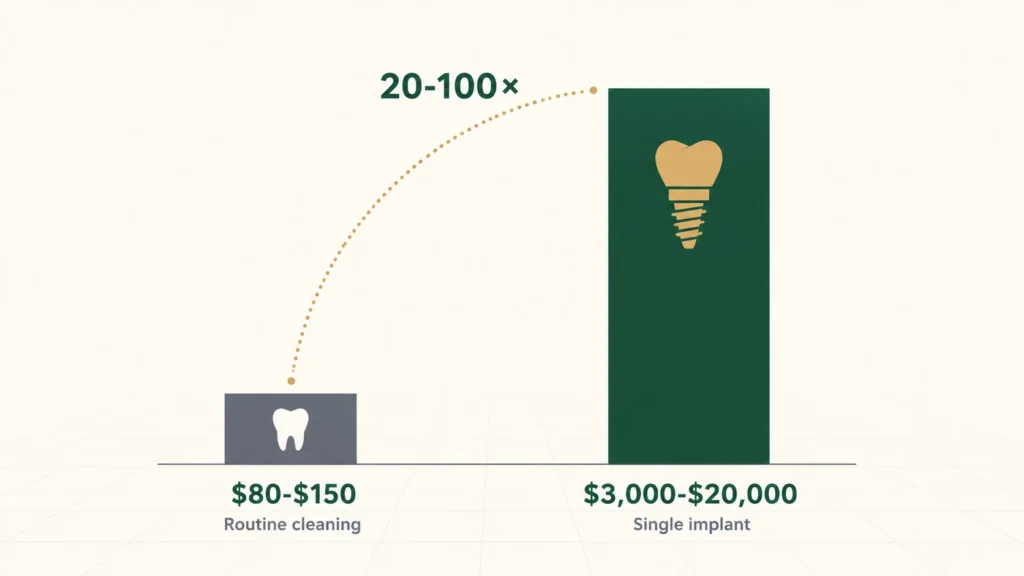
- Most practices run hygiene-style marketing on implant cases, losing $3,000 to $20,000 patients to competitors with proper implant landing pages, transparent financing, and HIPAA-compliant trust content. The 20 to 100 times revenue gap between an implant case and a hygiene visit punishes generic marketing strategies harder than any other service line.
- Our 387-keyword dental implant marketing corpus reveals where most practices misallocate budget: procedure-intent keywords (“dental implants near me,” “how much does a dental implant cost”) carry $16 CPC with 2.5 times the volume of provider-intent keywords at $22 CPC. Most practices target the wrong end, bidding aggressively on agency-search keywords while their patients search elsewhere.
- The five pillars that move the needle: patient segmentation across four implant audience types, high-converting landing pages with six conversion zones and transparent pricing, multi-channel reach (organic SEO, paid social, video, email/SMS nurture), local SEO and Google Business Profile optimization, and HIPAA/FTC compliance that compounds into competitive advantage.
- Walk away from PPC-only acquisition strategies, “free consultation” CTAs without financing transparency, generic homepages repurposed as implant landing pages, social testimonials violating FTC rules, and any agency promising ranking guarantees on competitive implant keywords.
- How to build the system: start with a free dental implant marketing audit surfacing the highest-impact gaps, prioritize landing page and Google Business Profile fixes (highest ROI, fastest to ship), then layer email/SMS nurture and paid channels once organic foundation is in place. The framework below shows what to build; the measurement section shows how to track it.
Why Implant Patients Are High-Value (and Why Most Practices Miss Them)
The most expensive dental implant marketing mistake is rarely bad ad spend or weak landing pages. It is targeting all four implant search intents through one undifferentiated funnel, then wondering why a $40,000 case still costs $6,000 to acquire. Practices treat implants like hygiene marketing, and the patients punish them for it.
A single implant case generates $3,000 to $6,000 in revenue. A full-arch case can exceed $20,000. A routine cleaning generates $80 to $150. This 20 to 100 times revenue gap is why dental implant marketing demands a different strategy, and why winning practices segment their patient funnel from day one.
Implant Patient Revenue vs. Average Dental Patient
| Procedure | Average revenue per case |
|---|---|
| Routine cleaning | $80–$150 |
| Crown / restoration | $1,000–$2,500 |
| Single dental implant | $3,000–$6,000 |
| Full-arch (All-on-4/X) | $20,000–$50,000 |
The demand side is just as decisive. The American Academy of Implant Dentistry estimates 2.5 million dental implants are placed each year in the United States, with roughly 500,000 new implant patients annually. The American College of Prosthodontists reports more than 120 million Americans are missing at least one tooth, and over 36 million are missing all their teeth. The addressable market is enormous, but every implant practice in your metro is bidding for the same Google clicks.
That competition shows up in cost-per-click data. Across our 387-keyword dental implant marketing corpus (US-only Semrush exports filtered for implant-related commercial intent, refreshed quarterly), the median CPC is $16.52, and individual high-intent terms can run well above that. Every dollar a competitor spends on a paid click is a dollar the practice with strong organic implant rankings does not have to spend.
This guide works through the full dental implant marketing toolkit: AI search, converting keywords, patient segmentation, landing pages, cost and financing display, HIPAA and FTC as competitive advantage, paid social and video, email/SMS nurture, and local SEO. For the wider dental SEO framework, see our complete guide to dental SEO.
How Is AI Search and the AI Tech Stack Reshaping Implant Patient Acquisition in 2026
AI Overview, ChatGPT Search, and conversational AI tools are increasingly the first stop for high-consideration medical decisions like dental implants. Dental implant marketing now competes for visibility inside those AI surfaces in addition to traditional organic listings. Pew Research Center found 72% of US internet users have looked online for health information in the past year, and 77% begin at a search engine. Implant patients spending $3,000 to $20,000 are exactly the research-heavy buyers AI search reshapes, both in which sources they consult first and how they interact with practice websites after arrival.

What Drives AI Overview Citation for Implant Content
Two patterns separate cited content from ignored content in AI Overviews. First, structural: schema markup helps search engines interpret pages, and Google Search Central documents MedicalBusiness, FAQPage, HowTo, and VideoObject as relevant for healthcare content. Second, content density: AI systems extract leading sentences as citation chunks, so the first sentences after every heading have to answer the question directly with numbers when possible. Implant queries trigger AI Overview at notably higher rates than general dental terms.
The AI Tools Reshaping Implant Practice Tech Stacks
Beyond AI search visibility, four AI tools are changing implant patient acquisition inside the practice:
- Website chatbots. Lead-response speed is one of the most consistent predictors of conversion across decades of sales research. Harvard Business Review and MIT analysis of more than a million sales leads found that contacting a prospect within 5 minutes makes a practice roughly 100 times more likely to reach them than waiting 30 minutes, and 60 times more likely to qualify the lead than waiting 24 hours. After-hours chatbots responding to implant inquiries at 11pm are exactly this speed-to-lead mechanism in practice.
- AI scheduling assistants. Imperial College London research found text message appointment reminders reduce no-show rates by 38%. AI scheduling tools layer additional capabilities on top (intelligent rescheduling, pre-consultation document collection).
- AI lead scoring. Predictive CRM scoring identifies which leads are 3 months from booking versus 12 months, prioritizing follow-up.
- AI-generated content concerns. YMYL classification means Google’s Quality Raters scrutinize dental content harder. Practices using AI to generate landing page copy without human medical review sit at structural disadvantage to practices with verifiable human authorship.
Beyond Google: Reddit, Voice Search, and Perplexity
Reddit is increasingly cited in Google AI Overview for medical research queries; implant subreddit threads regularly appear as authoritative consumer perspective. Voice search (“Hey Google, find an implant dentist near me”) routes through local pack and demands properly formatted GBP categories. Perplexity is gaining ground for research-stage implant queries among patients comparing All-on-4 options.
Dental implant marketing operates in a regulatory environment most dental marketers under-appreciate. Having written healthcare articles for Sanofi brands through Publicis, under medical-reviewer oversight, I can tell you dental implant marketing in 2026 is where pharma was in 2005: formal compliance rules exist, but most practices treat them as risk rather than as the structural advantage they become when implemented well. AI search rewards that discipline.
What Implant Keywords Matter Most for Practice Owners
Practice owners need to think about implant keywords across two distinct audiences rather than one. Patients search across four intent stages (research, comparison, local, cost). Practice owners and marketers search a separate cluster of keywords looking for implant marketing solutions, agencies, or guides. Both matter for an integrated dental implant marketing strategy: patient keywords drive your own SEO rankings, while practice-side keywords reveal what your competitors prioritize and what content you can publish to win industry visibility. The table below covers both clusters.
Where Most Practices Target the Wrong End
A counterintuitive finding from our 387-keyword dental implant marketing corpus: provider-intent keywords (“best dental implant marketing company”) average $22 CPC with combined volume of 540 monthly searches. Procedure-intent keywords (“dental implants near me,” “all on 4 dental implants”) carry $16 CPC with combined volume around 1,300, roughly 2.5 times the volume at lower competition. Most practices target the wrong end, bidding aggressively on agency-search keywords few patients ever type.
Dental Implant Keywords: Volume, CPC, and Ranking Difficulty
| Keyword | Monthly volume | CPC | KD | Intent stage |
|---|---|---|---|---|
| dental implants near me | 27,100 | $15.07 | 51 | Local |
| dental implants cost | 12,100 | $14.85 | 47 | Cost |
| all on 4 dental implants | 9,900 | $17.20 | 52 | Comparison |
| how much do dental implants cost | 6,600 | $14.50 | 42 | Cost |
| dental implant marketing | 720 | $16.52 | 8 | Practice-side |
| dental implant marketing ideas | 210 | $0 | 0 | Practice-side |
| all on 4 cost | 5,400 | $19.40 | 48 | Cost |
| mini dental implants | 4,400 | $11.30 | 39 | Comparison |
| financing dental implants near me | 1,300 | $47.23 | 36 | Cost (high intent) |
| dental implant procedure | 3,600 | $5.20 | 44 | Research |
Source: Dental Rank Lab 387-keyword implant corpus, Semrush US data. Volume and CPC figures reflect the export used for this article and shift between quarterly refreshes; treat them as relative signals rather than fixed values.
“Financing dental implants near me” carries the corpus’s highest CPC at over $47. The number reflects what the keyword tells you: the patient is shovel-ready, asking about payment, and every implant practice within twenty miles is bidding to be the answer.
Effective Dental Implant Marketing Ideas Beyond Pure Keyword Targeting
Pure keyword targeting hits diminishing returns. Effective dental implant marketing combines keyword content with three patterns: long-tail state variants (“dental implants in Phoenix”), procedure-specific content (“all on 4 recovery time”), and cost-transparency content. Practices winning organic implant traffic rank for 50-200 long-tail queries each. For the broader framework, see our guide on dental SEO keywords.
Who Are Your Real Implant Patients? Beyond Demographics
Demographic targeting alone fails for implants. The four implant patient segments respond to different ad creative, landing page headlines, and keyword sets, so dental implant marketing that treats them as one audience underperforms across all four.
The Four Implant Patient Segments
| Segment | Trigger | Decision driver | Best primary channel |
|---|---|---|---|
| Single-tooth replacement | Failed root canal, sports injury, congenital | Price + provider trust | Google search + Meta retargeting |
| Multi-tooth or bridge-alternative | Bridge failed, periodontal disease | Clinical credibility + longevity data | Long-form content + GBP |
| Full-arch (All-on-4/X) | Denture wearer ready for permanent | Financing + spouse involvement | Meta Ads + YouTube |
| Denture-to-implant converter | Frustrated with dentures | Bone candidacy + cost reassurance | YouTube + email nurture |
Single-tooth replacement patients are typically 35-55, decisive once they trust the provider, and price-aware but not price-driven. The trigger is usually an acute event. They convert quickly when a provider answers “am I a candidate” and “how much” without forcing a phone call.
Multi-tooth or bridge-alternative patients are 50-70, living with a failing bridge, and prioritize clinical credibility and longevity data over emotional appeal. They read provider bios in full.
Full-arch (All-on-4) patients are generally 55+, often long-term denture wearers, with the decision frequently involving a spouse. Financing is the dominant unlock. This segment responds strongly to before-and-after video.
Denture-to-implant converters carry the highest commercial intent with the lowest provider awareness. Their two questions are always “do I have enough bone” and “can I afford this.” Content that answers both directly captures a segment generic dental implant marketing misses entirely.
A Calibration for Lower-Volume Practices
Practices doing fewer than 5 implant cases per month should prioritize one segment first, typically single-tooth (natural inflow from general dentistry) or denture-to-implant (high intent, often invisible to mass marketing). High-volume practices and oral surgeons benefit from full four-segment structure with distinct landing pages per segment. Orthodontists offering implants face a slightly different audience overlap (see our orthodontist-specific SEO approach).
What Should a Dental Implant Landing Page Include to Convert
Dental implant marketing campaigns rise or fall on landing page quality. A high-converting implant page has six distinct zones: hero with location and outcome, social proof, candidacy and process diagram, pricing and financing, doctor credentials and technology, and FAQ with final CTA. Each zone serves a specific question implant patients arrive with. Generic dental homepages cannot convert implant traffic at $3,000 to $20,000 case values.
The Six Landing Page Zones
- Hero zone. Clear headline naming service, location, outcome (“Replace Missing Teeth With Dental Implants in [City], [State]”). One primary CTA, one trust signal, and a real photo of the doctor or office.
- Social proof zone. Testimonial video or before-and-after gallery within the first scroll. Implant patients evaluate emotionally before clinically.
- Candidacy and process zone. Plain-English “am I a candidate” answer with a three-step process diagram. Pre-qualifies leads and reduces no-shows.
- Pricing and financing zone. Specific monthly payment examples. Non-negotiable; next section covers why.
- Trust and credentials zone. Doctor bio, technology (CBCT scanner, guided surgery), and credentials.
- FAQ and final CTA. Six to ten questions covering pain, healing, longevity, candidacy with bone loss, insurance, warranty.
Add a mid-page CTA between zones 3 and 4. Page should load under 2.5 seconds on mobile with a sticky call button on smaller screens.
Implant Landing Page Conversion Elements
| Element | Why it matters | Priority |
|---|---|---|
| Real doctor photo above the fold | Patients evaluate provider before content | Critical |
| Specific pricing or monthly payment | Removes #1 conversion barrier | Critical |
| Before-and-after gallery (consented) | Visual proof outweighs descriptions | Critical |
| Sticky mobile call button | Captures patients on phone | Critical |
| Video patient testimonial | Builds emotional trust quickly | High |
| Process diagram | Demystifies the procedure | High |
| Schema markup (MedicalBusiness, FAQ) | AI Overview citation eligibility | High |
| Doctor credentials and CE | Multi-tooth and full-arch segments require this | Medium-high |
Landing Page Anti-Patterns That Tank Conversion
- Stock photos of generic models instead of the actual doctor and office
- Hidden pricing (“call for quote,” “starting at” with no ranges)
- Generic copy that could describe any dental procedure
- A single “Contact Us” CTA without a clear next step
- No mobile sticky call button
- No schema markup, leaving the page invisible to AI Overview
- No embedded video, missing the YouTube video carousel
For the broader audit framework, see our dental website SEO audits guide. If your implant page hides pricing or lacks a credentialed doctor photo, that is the highest-impact fix you can make this quarter.
How Should Cost and Financing Appear on Your Implant Page
Cost transparency is the single highest-impact conversion change in dental implant marketing. Peer-reviewed research (2024) examined why patients chose alternatives to implants. Cost was a barrier for 100% of those who declined, fear of surgery for 91%, underlying health for 81%, lack of knowledge for 80.5%, time management for 62%. Cost is the largest gate on implant treatment acceptance, ranking above every other concern. Practices showing specific monthly payment examples ($89/month for a single implant, $599/month for All-on-4) consistently outperform practices hiding pricing behind a contact form.
A separate 2024 cross-sectional study of 150 adults found 60% interested in implants but 45% considered them too expensive. Almost half of interested patients walk away because of cost perception before ever contacting a practice. “Financing available, ask us for details” forces patients to call before any reassurance about pricing. Most never make that call.
A Specific Payment Example Template
Here is a working pattern that converts well across implant practices:
Single tooth implant from $89/month with 0% APR for 24 months through CareCredit (subject to credit approval). All-on-4 from $599/month with extended terms available. We offer second-opinion consultations at no charge.
Three things make this work: the number is concrete (not “starting at”), the financing partner is named (signaling legitimacy), and the qualifier (“subject to credit approval”) is present (FTC-compliant).
Financing Partners Worth Naming in 2026
- CareCredit. Most recognized healthcare financing brand. Patients often qualify here when they would not elsewhere.
- Sunbit. Faster approval, friendlier to lower credit scores, good for single-implant cases.
- Cherry. Patient-friendly UX, strong for cosmetic and elective dental work.
- Proceed Finance. Higher loan amounts for full-arch cases, longer repayment terms.
- LendingClub Patient Solutions. Broad medical financing, common in multi-location practices.
Display two or three of these on the landing page, not all five. Implant patients are already overwhelmed by clinical options; making them choose between five financing providers adds friction rather than removing it.
Want to know if your current implant page covers these elements? Get a free audit →
How Do HIPAA and FTC Rules Shape Successful Implant Marketing in 2026
The implant practices winning in 2026 treat HIPAA and FTC compliance as competitive structure, not legal risk. Compliant before-and-after consent, properly disclosed testimonials, and FTC-aligned financing claims separate professional implant marketing from amateur marketing. Google’s E-E-A-T algorithm increasingly rewards the former, which means compliance now functions as a ranking signal in addition to a legal shield.
HIPAA-Compliant Photo and Video Consent
Before-and-after photos and patient testimonial videos require written photo authorization that exceeds standard HIPAA Privacy Rule patient consent. The standard practice HIPAA form covers treatment-related disclosure; it does not cover marketing image rights, social media posting, or website display. A separate marketing release is required, signed at consent, with specific language about where and how the image may be used. Most practices use generic HIPAA forms and assume they cover marketing use. They do not. Practices with documented separate marketing consent can post freely; practices without it operate with constant low-grade liability.
FTC Endorsement Guides 2023 Update
The Federal Trade Commission updated its endorsement guides in 2023 with specific implications for dental implant marketing. The requirements that matter most:
- “Results may vary” qualifier mandatory on before-and-after images (implant outcomes depend on bone density, hygiene, and other factors)
- Financing claims must disclose APR ranges and credit approval terms; “0% financing” with no qualifier is non-compliant
- Testimonials must be from real patients with documented consent; stock or composite testimonials are prohibited
- AI-generated images of patient results fall under the same prohibition on fabricated or unrepresentative depictions. The FTC treats a deceptive AI-generated endorsement the way it treats any other deceptive endorsement, and the 2023 update makes that reach explicit.
For the full text, see the FTC’s 2023 Endorsement Guides update.
What HIPAA Enforcement Actually Costs Dental Practices
The HHS Office for Civil Rights publishes its enforcement record openly. OCR has settled or imposed civil monetary penalties in 152 cases totaling more than $144 million, with dental practices appearing repeatedly:
- $10,000 settlement: dental practice social media disclosures of patient PHI
- $80,000 fine: dental and orthodontics provider, failure to provide timely patient records access
- $30,000 fine: dental practice, records-access failure
- Three separate dental practices named in a single 2022 OCR action on records-access violations
The American Dental Association publishes its own reference page on HIPAA penalties with the tiered penalty structure applying to every covered dental entity. In 2025, OCR resolved 21 separate HIPAA cases with financial penalties. “We are too small for HIPAA enforcement to matter” stopped being a defensible position years ago, with solo and small practices well represented in the record.
Why Compliance Becomes Competitive Advantage
Google E-E-A-T signals reward trustworthy content, and dental implant content gets YMYL (Your Money or Your Life) classification, meaning Google’s Quality Raters scrutinize it more closely. Practices with documented compliance protocols, properly attributed testimonials, and FTC-compliant disclaimers build more durable rankings. When competitors get hit with FTC inquiries or HIPAA complaints, compliant practices keep marketing while others spend months in remediation.
A free audit identifies HIPAA and FTC gaps most practices do not notice. Get yours →
The HIPAA and FTC summaries in this article are provided for general educational purposes and do not constitute legal advice. For specific compliance decisions affecting your practice, consult a qualified healthcare attorney.
What Content Builds Trust With Implant Candidates
Implant patients spend three to six months researching before booking. Content that builds trust during this window separates captured leads from competitor bookings. Trust-content production is the most consistently under-resourced layer of dental implant marketing. Five content types do most of the work.
- Before-and-after gallery (HIPAA-compliant consent). Visual proof outweighs written description. Twenty to fifty cases spread across patient segments tend to outperform five hero cases.
- Video patient testimonials (1-3 minutes). Authenticity beats production value: an unrehearsed patient generally outperforms a polished testimonial for high-trust decisions like implants.
- Cost transparency article. A dedicated page explaining cost range, what affects the final number, and financing options. Most implant websites refuse to do this, which is exactly why it works.
- Dentist credentials and implant training. Multi-tooth and full-arch segments check this specifically. CE hours, AAID or ICOI fellowship, training in specific implant systems.
- Recovery and aftercare guide. Honest content about the first 48 hours, first week, and first month removes the fear-of-recovery barrier.
Embedded testimonial videos and procedure walkthroughs should use VideoObject schema markup. YouTube embeds with proper schema appear in Google’s video carousel, which is additional SERP real estate beyond the organic text result.
Anti-Trust Signals That Quietly Cost Bookings
- No photo of the actual treating doctor on the implant page
- Generic stock photos throughout the website
- “Starting at $X” pricing with no ranges or context
- No FAQ addressing pain, cost, or candidacy
- Negative Google reviews with no responses, or all responses copy-pasted
BrightLocal’s most recent Local Consumer Review Survey finds 50% of consumers trust online reviews as much as personal recommendations. For high-consideration implant decisions at $3,000 to $40,000, the trust threshold is even higher. Practices without recent, responded-to, service-specific reviews lose implant patients silently.
How Do Paid Social, Video, and YouTube Build Implant Demand Beyond Search
Dental implant marketing through search alone caps reach at patients who already know they want an implant. Paid social and video extend reach to patients who fit the implant candidate profile but have not started researching online yet. For practices scaling beyond search, paid social and video often become a primary source of new implant demand among awareness-stage segments.
Meta Ads for Dental Implant Marketing
Demographics-driven targeting works for implants in ways it rarely does for other dental services. Age, life-event signals, and interest parameters available in Meta’s targeting all map cleanly to implant candidate populations. Four campaign segments produce the best results:
- Single-tooth retargeting to landing page visitors who did not convert
- Full-arch awareness to denture wearers and prospective denture replacements
- Educational lead magnet (“Free guide: Is All-on-4 right for you?”)
- Doctor introduction video to local audiences within a 20-mile radius
Meta’s Business Help Center documents minimum daily budgets ($5/day for clicks, $10-$20/day for conversions) and notes ad sets need approximately 50 conversion events per week to exit the learning phase. For implant marketing, this typically requires meaningful monthly spend rather than the daily minimums. Meta also requires HIPAA-compliant ad copy under its healthcare advertising policies.
YouTube as a Search Engine, Not a Social Network
YouTube is the second-largest search engine. Implant patients heavily research there during comparison and cost stages, watching procedure walkthroughs, patient testimonials, and “what to expect” content. YouTube SEO basics that move the needle:
- Video titles include the primary keyword and location when relevant
- Structured chapters (timestamps) help videos rank
- End screens drive viewers to the next video in the funnel
- Playlists organize content around patient segment
Short-Form Video on Reels, TikTok, and YouTube Shorts
Short-form video serves a different function: top-of-funnel awareness. Practices posting one to three short videos per week tend to outperform long-form-only practices on implant patient acquisition. Formats that work: 30-second before-and-after reveals (consented), staff and team intros, “myth vs. fact” implant explainers, and time-lapse procedure clips.
Most US dental practices treat short-form video as social media filler. In stricter regulatory verticals (pharma, regulated medical devices), every short-form video clears the same approval pipeline as long-form content. The discipline produces higher quality, which the platforms reward with more reach.
Channel Function Within an Integrated Implant Funnel
These channels serve distinct functions rather than competing. Organic SEO and GBP capture active search intent. Meta Ads and YouTube reach segments not yet searching. Email/SMS nurture multiplies every channel by converting cold leads across the 3-6 month decision cycle. The right mix depends on local competition and consultation capacity.
How Do Email and SMS Nurture the 3-6 Month Implant Decision Cycle
The implant decision cycle is the longest in dentistry, which makes nurture the most under-built channel in dental implant marketing. Patients who do not book at first contact average three to six months before deciding. Forrester Research finds companies excelling at lead nurturing generate 50% more sales-ready leads at 33% lower cost than organizations without structured nurture. The fix is an 8-touch email sequence combined with SMS micro-nudges across 90-180 days.
The 8-Touch Email Nurture Sequence
- Day 0: Welcome + consultation confirmation or brochure download
- Day 3: “What to expect at your consultation” video
- Day 7: Cost transparency article + financing options
- Day 14: Patient story matched to the lead’s segment
- Day 30: “Still researching?” check-in with FAQ
- Day 60: Second segment-matched testimonial
- Day 90: Updated promotion, new patient offer, or seasonal financing
- Day 120-180: Quarterly newsletter with implant content
This sequence matches the patient’s actual decision timeline. A patient who downloaded a guide on Day 0 is typically not ready to book until Day 60 or later. Email keeps the practice present without being aggressive.
SMS Micro-Nudges
Patients respond faster to SMS than email. Gartner Research reports SMS open and response rates at 98% and 45% versus 20% and 6% for email. Three to four SMS touches over 90 days, used strategically, outperform daily SMS bombardment:
- Appointment reminders with one-tap reschedule
- Consultation availability for high-intent leads who never booked
- Single-question check-ins (“Still considering implants? Reply YES for an updated quote.”)
- Financing reminders after FTC-compliant disclosure
Email vs. SMS Performance for Implant Patient Nurture
| Channel | Avg response rate | Best use case | Compliance considerations |
|---|---|---|---|
| ~6% (per Gartner) | Long-form content, education | CAN-SPAM, HIPAA for treatment details | |
| SMS | ~45% (per Gartner) | Appointment reminders, time-sensitive offers | TCPA opt-in required, HIPAA for treatment details |
Compliance, Tracking, and Closed-Loop Attribution
SMS marketing requires explicit written opt-in. Implant patient data (treatment plans, before-and-after photos) requires encrypted storage, which PMS-integrated nurture handles more compliantly than standalone platforms (though with less flexibility). Closed-loop attribution then needs to track the full chain: source (keyword, ad, organic page) → lead → consultation booked → attended → case accepted → revenue collected. Call tracking with dynamic number insertion captures source. CRM/PMS integration captures booking and attendance. Closing the loop means each system talks to the others, so the practice can see which keyword produced the last $40,000 case.
How Does Local SEO Work for Implant Searches

Most implant searches carry local intent, which is why local SEO sits at the foundation of every dental implant marketing campaign that actually produces booked consultations. Local pack visibility is therefore as important as organic ranking for implant terms. Think with Google reports that 60% of smartphone users have contacted a business directly from local search results, often through the click-to-call option that map pack listings display by default. For implant practices, the local 3-pack is where roughly half of all local clicks go before any other ranking factor matters.
Three Levers That Move Implant Local Rankings
- Add dental implants explicitly to your GBP services. Most practices select “Dentist” as primary category and stop. Add secondary categories like “Cosmetic dentist” or “Dental implants periodontist” where applicable, and list “Dental implants,” “All-on-4 implants,” and “Single tooth implants” as individual services with descriptions.
- Generate Google reviews that mention “dental implants” by name. Service-specific keywords inside reviews are a strong local relevance signal. After implant cases, send a follow-up text prompting patients to mention procedure type.
- Build city-plus-service combination pages for genuine local search demand. “Dental Implants in [City]” can be a separate URL from the main implants page. Avoid duplicating content across “Dental Implants in [Suburb]” pages; Google flags those as doorway pages.
One audit pattern illustrates the cost of skipping this. An implant-focused practice had completed 40 cases the prior year, but their GBP listed “Dentist” as the only category, no implant services, and 6 photos. Organic ranking for their primary implant keyword sat outside the top 30. The fix was operational: full GBP optimization plus structured review-request workflow. Within 90 days they were ranking in the local 3-pack. We offer standalone GBP optimization at a fixed price for practices needing targeted work.
Why Does SEO Plus Comprehensive Marketing Beat PPC-Only for Implants? The Math
Paid implant clicks command some of the highest prices in dental advertising, which is why dental implant marketing strategy fails when it relies on PPC as the primary patient acquisition channel. Our 387-keyword corpus contains procedure-intent keywords priced from $11 to $47 per click (with “financing dental implants near me” at $47 the top of the range). Organic rankings replace that variable cost with a fixed content and optimization investment that compounds over time.
Channel Tradeoffs: Speed vs. Long-Term Cost
| Channel | Time to first leads | Variable cost per lead | Cost trajectory over time |
|---|---|---|---|
| Google Ads (PPC) | 1-2 weeks | High and consistent (every click costs) | Flat to rising with auction competition |
| Organic SEO | 3-6 months | Approaches zero once ranking | Decreasing per additional lead |
| Meta Ads | 1-2 weeks | High and consistent | Stable to rising |
| YouTube long-form | 2-4 months | Low after production cost | Decreasing per additional view |
| Email/SMS nurture | Immediate (after list build) | Very low (automation) | Negligible incremental cost |
The 387-keyword dental implant marketing corpus shows median organic CPC at $16.52, with high-intent variants like “financing dental implants near me” at $47. That is the cost-per-click an implant practice avoids paying every time it ranks organically. Multiplied across hundreds of long-tail variations, the savings drive the math for any practice doing more than five cases per month.
When PPC Still Makes Sense
PPC is the right primary channel in three scenarios: new practice locations needing lead flow before organic catches up, practices launching a new procedure (e.g., adding full-arch to single-implant), and established practices facing temporary capacity gaps that benefit from PPC’s on/off control. For most established implant practices, the right answer is hybrid: PPC for short-term volume, organic SEO for long-term cost-per-case decline, other channels as multipliers on both.
If you are evaluating implant marketing providers rather than building in-house, the criteria that separate strong dental SEO companies from weak ones deserve a read. Our services range from standalone GBP audits at $400 to monthly programs from $1,000.
What Should You Measure in Dental Implant Marketing
Dental implant marketing has the longest sales cycle of any common dental service, which means the wrong measurement framework leads to the wrong conclusions about which channels produce revenue. Most practices measure nothing past “how many leads did we get” or track too many vanity metrics that do not tie to revenue. A small set of measurement points carries most of the signal.
Top-of-funnel reach:
- Organic impressions on implant keywords (Google Search Console)
- Local pack impressions for “implant” queries in your service area
- YouTube and short-form video views on implant content
Mid-funnel engagement:
- Implant landing page sessions and time-on-page
- Implant landing page conversion rate (forms or call clicks per session)
- Email open/click rates on implant nurture sequences
- SMS response rates on implant follow-ups
Bottom-of-funnel and revenue:
- Consultation booking rate (consultations booked per qualified lead)
- Show-up rate for booked consultations
- Case acceptance rate (consultations that become signed treatment plans)
- Average case value by patient segment
- Cost per booked consultation by channel
- Cost per accepted case by channel
- Revenue attributed to each channel within 90 days
The two most under-measured numbers in dental implant marketing are case acceptance rate and revenue attributed by channel. Practices that track both stop spending money on channels that produce consultations but never close, and start spending more on channels that produce signed treatment plans even at higher cost per consultation.
Practices doing fewer than 5 implant cases per month should prioritize BOFU metrics (case acceptance, average case value, cost per accepted case). High-volume practices need all three tiers because dental implant marketing at scale only stays profitable when every layer is measured.
Frequently Asked Questions
How long does dental implant marketing take to show results? Three to six months for first ranking lifts, six to twelve for consistent top-three positions on competitive implant keywords. Secondary markets often see results faster. Combining SEO with paid channels accelerates lead flow during the SEO ramp-up.
Should I market specific implant brands (Nobel Biocare, Straumann) or just “dental implants”? Market procedure and outcome, not brand. Patient searches focus on “dental implants near me” and “how much do implants cost.” Brand-specific searches account for less than 3% of total implant search volume.
Can a general dentist compete with implant specialists for the same keywords? Yes, with the right positioning. Patients searching “dental implants [city]” do not distinguish between GPs offering implants and specialists. Content depth, credentialing display, and before-and-after evidence matter more than degree. Practices winning implant keywords typically have implant-specific landing pages, schema markup, and clear credentials.
What’s the ROI of dental implant marketing compared to marketing for other dental services? The highest of any common dental procedure. A practice generating 10 additional cases per year from improved SEO at $4,000 average revenue produces $40,000 in incremental revenue. Once ranking organically, each additional lead carries near-zero variable cost, so returns compound rather than reset with each ad campaign.
Putting Implant Marketing Into Action
Effective dental implant marketing combines five integrated pillars: patient segmentation that determines creative and keyword fit, high-converting landing pages with transparent pricing and HIPAA-compliant proof, multi-channel reach across organic search, paid social, video, and email/SMS nurture for the 3-6 month decision cycle, local SEO that captures “near me” intent, and compliance discipline (HIPAA, FTC, E-E-A-T) that protects rankings against algorithm updates and regulatory tightening. The math on a single implant case ($3,000 to $20,000 in revenue) justifies the investment in doing all five correctly.
To see where your practice stands across these pillars, we run free dental SEO audits with implant-specific assessment covering landing page conversion, GBP optimization, keyword coverage, and compliance gaps.
Request a free dental SEO audit →
Sources and References
Academic and Peer-Reviewed Research
- Oldroyd, J.B., et al. “The Short Life of Online Sales Leads.” Harvard Business Review, 2011 (Lead Response Management Study).
- Bigus, K., et al. “Cost-Related Barriers to Dental Implant Treatment.” Cureus, 2024.
- “Patient Perception and Cost Barriers to Dental Implant Treatment.” Cross-sectional study, 2024.
- Imperial College London, Department of Primary Care and Social Medicine. Text message appointment reminders and 38% no-show reduction.
Industry and Market Research
- Pew Research Center: consumer health information seeking (72% / 77%).
- Forrester Research: lead nurturing performance (50% / 33%).
- Gartner Research: SMS vs email response rates (98%/45% vs 20%/6%).
- Think with Google: mobile search and local business contact (60% click-to-call).
- BrightLocal Local Consumer Review Survey: consumer trust in online reviews (50%).
Professional Associations and Clinical Statistics
- American Academy of Implant Dentistry (AAID): US annual implant statistics (2.5M placed; 500K new patients).
- American College of Prosthodontists (ACP): US tooth loss statistics (120M / 36M).
- American Dental Association: HIPAA Penalties for Dental Practices.
Government and Regulatory
- HHS Office for Civil Rights (OCR): HIPAA enforcement record (152 cases, $144M+).
- Federal Trade Commission: Endorsement Guides, 2023 Update.
Platform Documentation
Internal Research Asset
- Dental Rank Lab 387-keyword dental implant marketing corpus. US-only Semrush exports filtered for implant commercial intent, refreshed quarterly.
Last updated: August 23, 2026
About the Author

Copywriter and SEO specialist with 18 years of experience in marketing, including healthcare and pharmaceutical clients such as Sanofi. He focuses on dental SEO strategy, combining healthcare content expertise with data-driven local search analysis.
Get a free dental SEO audit