What Does a Dental Website SEO Audit Actually Check in 2026?
Last updated: April 2026
Key Takeaway: A dental website SEO audit examines your website’s technical health, keyword targeting, Google Business Profile, and local citation consistency. Most dental website SEO audits surface 15 to 30 fixable issues. In our experience, the three that appear most often are missing service-plus-location keyword combinations, an incomplete Google Business Profile, and mobile page speed that fails Google’s Core Web Vitals threshold. Each of these has a direct, measurable impact on how many new patients call your practice. The output of a proper dental website SEO audit is a ranked action list, with the highest-impact fixes typically showing ranking improvements within 4 to 8 weeks and more significant gains accumulating over 90 to 120 days.
Most dental practices that come to us after working with a previous SEO provider share the same complaint: they received monthly reports full of numbers, and still couldn’t tell whether any of it was working. Traffic up 12%. Domain authority improved. Rankings for their practice name holding steady.
What they weren’t getting: new patients from organic search.
The problem usually starts at the audit stage. A real dental website SEO audit doesn’t inventory your website’s features, but rather identifies the specific gaps between where you rank now and where you need to rank to fill your appointment book. If your audit didn’t answer that question, it wasn’t an audit. It was a diagnostic theater.
Here’s what a useful one actually covers.
What Is a Dental Website SEO Audit?
A dental website SEO audit is a structured diagnostic that identifies every factor suppressing your practice’s visibility in local search, and ranks those factors by their impact on new patient acquisition. It ends with a short prioritized list: fix these things first, here’s why, and here’s what it will change.
What Technical Issues Do Most Dental Websites Have?
Technical problems are the ones that make everything else irrelevant. A page that Google can’t properly crawl doesn’t rank, regardless of how well-written it is, and a dental website SEO audit surfaces these first.
We reviewed 20 dental practice websites across competitive US markets and found that 16 had at least one service page with a title tag containing no location identifier. Of those same 20 sites, 13 failed Google’s mobile Core Web Vitals threshold. These are not edge cases. They are the baseline.
The issues that consistently appear:
- Slow mobile page speed. Google research found that 53% of mobile users abandon a site that takes more than three seconds to load, a benchmark that subsequent Core Web Vitals studies have continued to validate. Dental websites built on aging themes or loaded with uncompressed before-and-after photos regularly fail this threshold. Page experience, including load speed, is a confirmed component of Google’s ranking systems.
- Duplicate or missing title tags. These are the first signals Google reads to understand what a page is about. Practices with 30 pages on their site often have identical title tags across a dozen of them. Google sees a confusing website with no clear topic authority. Patients don’t see the page at all.
- Pages blocked from indexing. Misconfigured robots.txt files or leftover “noindex” tags from a development phase can prevent Google from seeing entire sections of your site. This happens more often than you’d expect after a redesign, and it can sit quietly destroying your visibility for months while you wait for SEO to “kick in.”
- Broken internal links. Dead ends inside your site are a crawlability problem and a user experience problem simultaneously. Neither Google nor a patient looking for your implant page benefits from a link that goes nowhere.
These aren’t subtle optimizations. They’re structural problems with immediate fixes that unblock everything else.
Are Your Pages Targeting the Right Keywords?
On-page analysis answers a single practical question: are the right words on the right pages? This section of the dental website SEO audit maps what your pages currently target against what patients actually search.
The most common answer is no, and for a specific reason. Dental websites are typically built by designers, not patient acquisition strategists. The result is a clean, professional site with a “Services” page, a few treatment subpages, and a contact form. That structure looks fine. It performs poorly.
What actually gets patients to your pages:
Service-plus-location combinations. “Dental implants in Austin, TX” is a different search than “dental implants.” The first has local intent. The patient is ready to book. The second might be someone researching the procedure from anywhere. Your pages need to target the first category, and most don’t. See a full breakdown of which keywords to prioritize in our guide to dental SEO keywords for 2026.
Keyword cannibalization. When two pages on your site compete for the same search term, they split your authority and dilute your ranking potential. We regularly find dental practices with a general “services” page and a specific “dental implants” page, both optimized for the same phrase. Neither ranks as well as one consolidated, properly structured page would.
Content depth vs. what your competitors have. Google rewards pages that thoroughly answer patient questions. A 200-word implant page is not competing effectively with a competitor’s 1,400-word page covering costs, candidacy, recovery, and what to expect. The dental website SEO audit shows you that gap and tells you exactly how wide it is.
How Does Your Google Business Profile Compare to Competitors?
For most dental practices, the Google Business Profile drives more patient calls than the website does. The local map pack, the three results that appear above organic listings for “dentist near me” searches, is driven primarily by GBP signals alongside your website’s relevance and local authority.
According to BrightLocal’s Local Consumer Review Survey, 98% of consumers searched online for a local business last year. The GBP is usually the first result they see and the first thing that determines whether they call you or your competitor.
Every thorough dental website SEO audit includes a GBP review. What it checks, and where most practices fall short (full optimization guide: how to optimize your Google Business Profile for more dental patients):
Category selection. Most practices select “Dentist” as their primary category and stop. Missing secondary categories like “Cosmetic Dentist,” “Orthodontist,” or “Dental Implants Periodontist” means missing every search query tied to those categories. That’s not a small gap.
Service listings. GBP lets you add individual services with descriptions. The majority of practices leave this section empty. Every incomplete field is a signal your profile sends to Google about how relevant and active your practice is.
Review profile. Volume, recency, average rating, and how consistently you respond to reviews all influence local pack ranking. But the competitive context matters as much as the raw numbers. If every top-ranked competitor in your market has 300 reviews and you have 40, that’s the actual gap the audit needs to surface.
Posting activity. Practices that publish regular GBP updates signal to Google that the profile is actively managed. Profiles with years of inactivity get treated accordingly.
What Does a Backlink and Citation Audit Reveal?
These are two different signals that are often bundled together, and the distinction matters. The backlink and citation section of a dental website SEO audit tells you whether the broader web is working for or against your local visibility.
Local citations are mentions of your practice name, address, and phone number across directories: Yelp, Healthgrades, Zocdoc, and dozens of others. The audit checks consistency. A suite number written three different ways, a phone number that changed two years ago but still appears on 15 listings, an old address still live on a directory you forgot existed. Google’s local ranking guidelines treat NAP consistency as a foundational local relevance signal. Inconsistencies actively undermine your local rankings.
Backlinks are links from other websites pointing to yours. Google still treats these as credibility signals. The audit looks at how many referring domains you have versus competitors, whether any links come from spammy or irrelevant sources (which can hurt rather than help), and whether your local backlink profile includes sources that carry weight for dental practices: local news coverage, chamber of commerce membership, and dental association directories.
A practice with zero local backlinks is at a structural disadvantage against a competitor with even ten quality local links. The audit shows you exactly how large that gap is and where the fastest opportunities to close it are.
What Happens After You Get Your Dental Website SEO Audit Results?
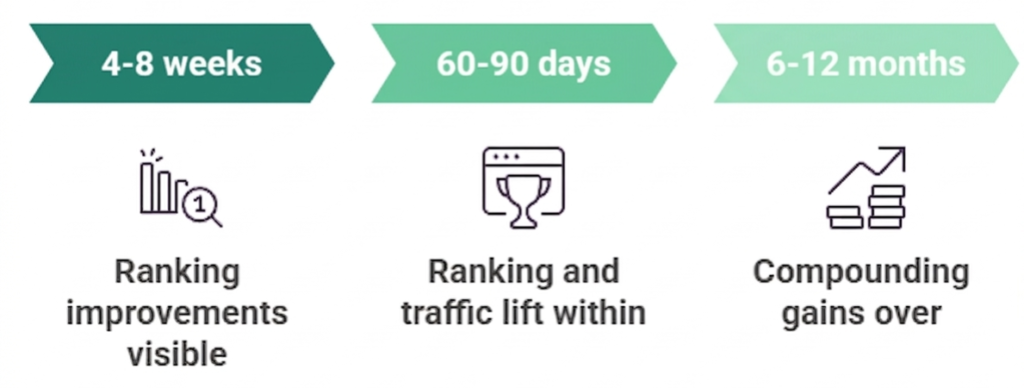
The output of a useful audit is a ranked action list, organized by how directly each fix affects new patient volume. Here’s how those fixes typically fall out:
| Priority | Typical issues | Time to fix | Expected impact |
|---|---|---|---|
| Fix immediately | Missing or duplicate title tags, GBP category gaps, NAP inconsistencies across directories | Hours to one day | Ranking improvements visible within 4 to 8 weeks |
| Fix within 30 days | Slow mobile page speed, keyword cannibalization, indexation errors, thin service pages | Several days to two weeks | Ranking and traffic lift within 60 to 90 days |
| Ongoing program | Missing or duplicate title tags, GBP category gaps, and NAP inconsistencies across directories | Continuous | Compounding gains over 6 to 12 months |
The first category is where most audits pay for themselves in the first month. Title tag corrections cost nothing but time in your CMS. Correcting a wrong phone number across 15 directory listings is an afternoon of work. These aren’t optimization experiments. They’re structural fixes with predictable outcomes.
The second category is where the gap between practices with SEO strategies and practices without them becomes durable. A dental practice that builds out properly targeted, content-rich pages for dental implants, Invisalign, and veneers will rank for those searches. A competitor whose entire site is a five-page brochure won’t.
The third category is where that gap becomes permanent.
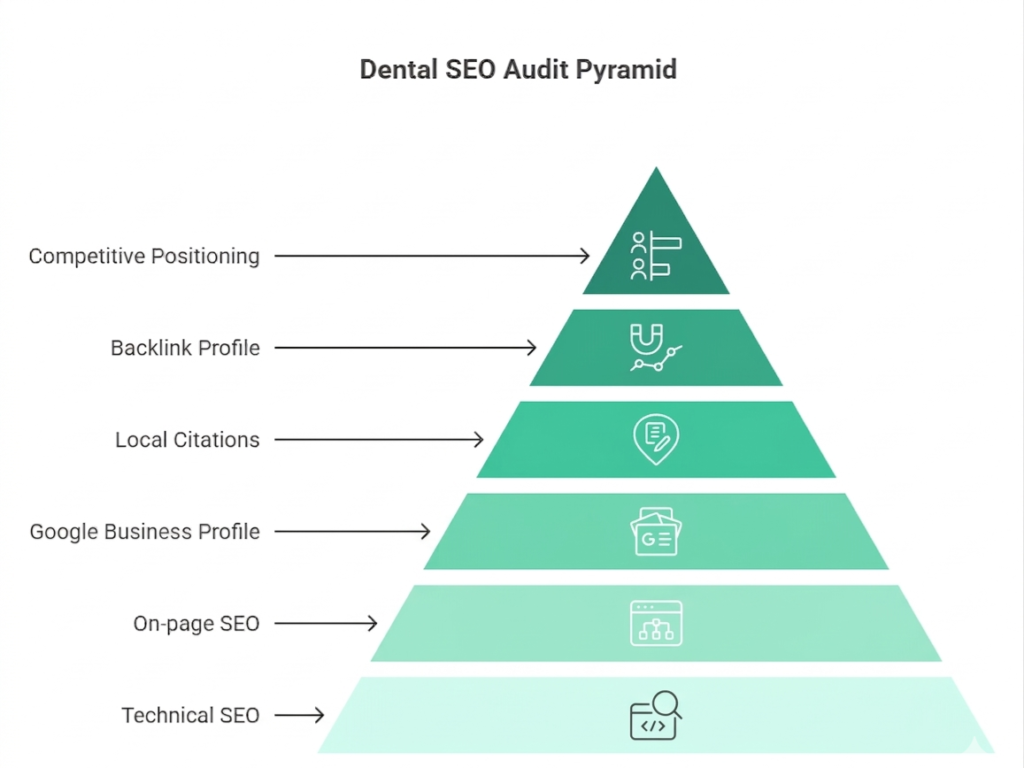
What Each Part of a Dental Website SEO Audit Covers
| Audit area | What we check | Why it matters | Common red flags |
|---|---|---|---|
| Technical SEO | Crawlability, page speed, indexation, mobile usability, Core Web Vitals | Prerequisite for everything else | Pages returning 404 errors, mobile speed score below 50, noindex tags left over from a redesign |
| On-page SEO | Title tags, meta descriptions, H1 structure, keyword targeting, content depth | Tells Google what each page is about and whether it’s relevant to local searches | Duplicate title tags, missing city or service keywords, service pages under 400 words |
| Google Business Profile | Categories, service listings, photo volume, review profile, posting activity | Drives local map pack rankings directly | Single category selected, zero GBP posts in 90 days, fewer than 20 photos |
| Local citations | Title tags, meta descriptions, H1 structure, keyword targeting, and content depth | Reinforces local relevance signals that Google uses to validate your location | Address listed in three variations, old phone number still live on 10 directories |
| Backlink profile | NAP consistency across 30+ directories, including Yelp, Healthgrades, Zocdoc | Builds domain authority over time | Zero local backlinks, links from irrelevant directories, large gap versus top competitors |
| Competitive positioning | How your rankings, GBP signals, and content depth compare to the top three local competitors | Defines the specific gap between where you are and where you need to be | Competitors have 4x your review volume and dominate every high-value service keyword |
Frequently Asked Questions
How much does a dental website SEO audit cost?
Free dental website SEO audits exist, but are typically automated reports with no prioritization or strategy. A genuine audit, where someone reviews your site, GBP, citation profile, and competitors, costs between $300 and $800 as a standalone service. Many SEO agencies fold the audit into onboarding when you sign a retainer. We offer ours for free because it’s the clearest way to show what we’d actually fix.
How long does a dental website SEO audit take?
A thorough dental website SEO audit takes 5 to 10 business days. Faster turnarounds usually mean an automated crawl with a generated report attached. The time-consuming part is the competitive analysis: understanding not just what’s wrong with your site, but how those gaps compare to the practices currently ranking above you.
What’s the difference between a free and a paid dental website SEO audit?
Automated tools can crawl your site and flag technical errors in minutes. A professionally delivered dental website SEO audit adds three things the tools can’t: competitive context (how do you compare to the top 3 local competitors?), keyword prioritization (which gaps are worth fixing first, given your market?), and a ranked action plan tied to patient acquisition, not rankings for their own sake.
How often should a dental practice get an SEO audit?
Once at the start of an SEO program, and then annually as a checkpoint. Monthly SEO reporting should track the metrics that came out of the initial dental website SEO audit. A full re-audit makes sense when you redesign your site, move locations, add a major service, or notice a significant drop in organic traffic or calls.
The goal of any dental website SEO audit is to walk away knowing exactly what to fix, in what order, and why it matters for new patient volume. If the last audit you received didn’t answer those three questions, it was a report, not a diagnostic.
Request your free dental website SEO audit and see what a prioritized diagnostic actually looks like for your practice.
Related reading:
- What Dental SEO Keywords Should Your Practice Target in 2026?
- How to Optimize Your Google Business Profile for More Dental Patients
About the author

Copywriter and SEO specialist with 18 years of experience in healthcare and B2B marketing, including work with global pharmaceutical clients like Sanofi. He focuses on dental SEO strategy, combining healthcare content expertise with data-driven local search analysis.
Get a free dental website SEO auditSources: [1] Google, The Need for Mobile Speed – https://www.thinkwithgoogle.com/consumer-insights/consumer-trends/mobile-site-load-time-statistics/ [2] BrightLocal Local Consumer Review Survey, 2024 – https://www.brightlocal.com/research/local-consumer-review-survey/ [3] Google Search Central, Improve your local ranking on Google – https://support.google.com/business/answer/7091