The Complete Guide to Dental SEO (2026)
Key Takeaway: Dental SEO is the practice of making a dental website, Google Business Profile, and local online presence visible when patients search for dental services. The four pillars are on-page content, technical health, local search, and backlinks. Most practices see first measurable results in 30-90 days, full ROI in 9-12 months, and ongoing returns that compound over years. The single biggest leverage point in dental SEO is Google Business Profile, which controls visibility on roughly 60% of total dental search volume.
Start Here If You Own a Dental Practice (30-Second Version)
If you have 30 seconds, here is the entire guide compressed:
- Most important lever: Google Business Profile. It is the dominant SERP feature on dental searches by a wide margin. Optimize it first, before touching anything else.
- Expected timeline: First measurable results in 30-90 days, full ROI in 9-12 months.
- Typical investment: $2,000-$3,000 per month is the legitimate range for most single-location practices.
- The five things that move rankings: an active and complete GBP, a fast mobile website, dental-specific content written for local patients, consistent NAP citations across directories, and authentic review volume.
- The five biggest red flags: thin or duplicate content, a slow or schema-less website, abandoned blog, inconsistent phone numbers across listings, and an agency that promises rankings in 30 days.
If you want the reasoning, methodology, and worked examples behind each of these, read on.
What Is Dental SEO and Why Does It Matter in 2026?
If you’ve watched a previous marketing agency disappear $2,000 a month while your phone schedule looks the same, this guide starts from a different place. Dental SEO is a measurable channel with timelines, costs, and metrics that fit on a single page. The rest is execution.
So what makes dental SEO different from the generic “SEO” your previous agency talked about? Dental SEO is the practice of optimizing a dental website, Google Business Profile, and local online presence so the practice appears when patients in your area search for dental services. Done well, it becomes one of the highest-ROI long-term marketing channels available to general dentists, orthodontists, and specialists, for one specific reason: patients use Google before they ask anyone else about a new dentist, and they trust what they find there more than almost any other source of information. Done poorly, it costs $2,000 a month for nothing.
The scale of dental search is larger than most practices realize. We analyzed 110,000 U.S. dental search keywords covering 12.2 million combined monthly searches. The single biggest term, “dentist near me”, carries 823,000 monthly U.S. searches by itself. Add “wisdom teeth removal” at 90,500, “emergency dentist” at 60,500, and “dental implants near me” at 49,500, and a handful of head terms account for more than a million monthly patient inquiries in the United States. The opportunity is large. The competition for the top of the page is also large.
What’s changed in 2026 is not the basic mechanics of SEO. The fundamentals (helpful content, fast websites, accurate local listings, real reviews) work the same way they did five years ago. What’s changed is the SERP itself. AI Overviews answer some queries above the click line. Google Business Profile data now feeds AI recommendation systems. And the recent spam updates have made keyword-stuffed and AI-padded content actively harmful to rankings. The practices that adapt will compound their visibility. The ones that don’t will quietly lose pageviews each quarter without understanding why.
The rest of this guide walks through the four pillars of dental SEO, what each one actually involves, how long results take, what they cost, and what to measure. If you want a faster start on the diagnostic side, our complete dental website audit checklist walks through that first.
How Is AI Search Changing Dental SEO in 2026?
AI Overviews, ChatGPT Search, and Perplexity have changed how patients find some kinds of dental information, but they have not replaced the dominant SERP feature on most patient searches: the Local Pack. Across 110,000+ dental keywords in our corpus, AI Overview appears in 8.6% of queries and captures 19.5% of total search volume. Google Local Pack appears in 17.2% of queries but captures 60% of total search volume. For dental practices, that single comparison should anchor every SEO decision. Google Business Profile remains the highest-leverage asset. AI Overview is a secondary consideration for high-volume informational queries.
The reason AI Overview underperforms on dental SERPs comes down to query intent. Most dental searches are local and transactional: “dentist near me”, “emergency dentist near me”, “pediatric dentist [city]”. Google’s behavior on these queries strongly favors the Map Pack, which gives the searcher a list of nearby clinics, ratings, and direct call buttons in two seconds. An AI summary adds friction in that flow. Where AI Overview does dominate is on informational long-tail queries: “is wisdom teeth removal painful”, “how long does Invisalign take”, “what causes tooth sensitivity”. These are content marketing opportunities for practice blogs, not direct patient acquisition channels.
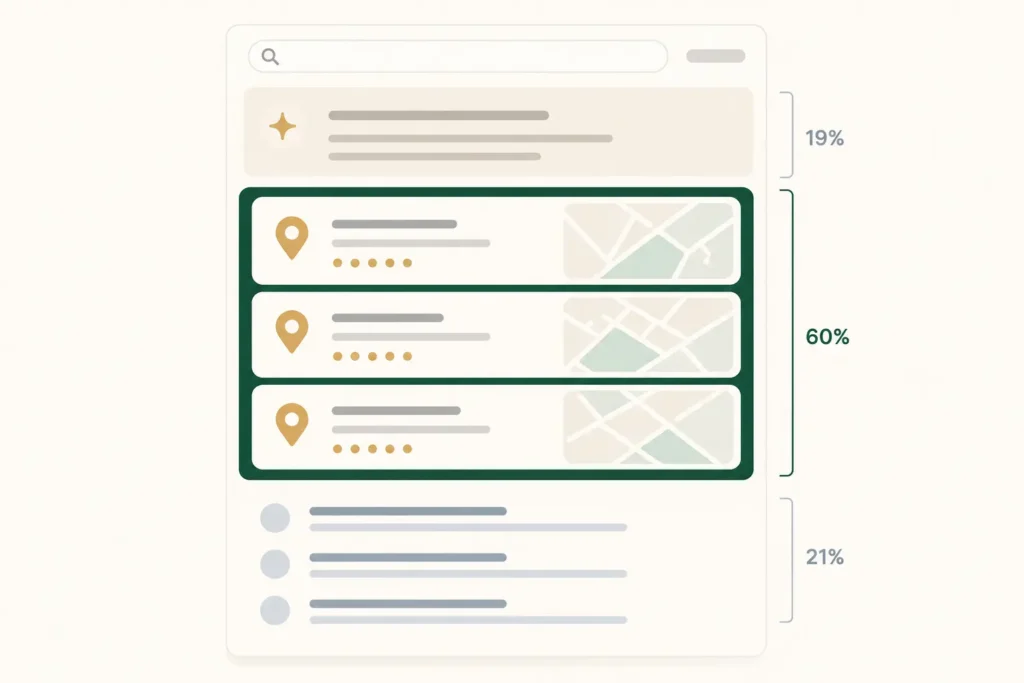
Here’s how the seven main SERP features distribute across dental keywords:
| SERP feature | % of dental keywords | % of total search volume | What it means for your practice |
|---|---|---|---|
| Local Pack | 17.2% | 60% | The most important SERP feature on dental search. Google Business Profile is the highest-leverage single asset. |
| Video carousel | 19.3% | 68% | YouTube embedding and short-form video become near-required for high-volume terms. |
| Sitelinks | 20.3% | 69% | Strong site architecture and clear page hierarchy expected. |
| Image pack | 19.6% | 56% | Before-and-after galleries and service photos matter. |
| People Also Ask | 13.6% | 28% | Question-format headings and FAQ schema get pulled into expanding boxes. |
| AI Overview | 8.6% | 19.5% | Less prevalent than expected. Concentrated on informational long-tail queries. |
| Featured Snippet | 1.1% | 2.1% | Open opportunity. Position zero sits empty on most dental SERPs. |
Sitelinks and video carousels appear on more total volume, but they behave differently. Both are passive features that sit alongside the organic results. The Local Pack is a destination: it lists nearby practices with ratings, hours, and a call button, and the searcher can act on it without ever reaching a website. That is why we treat it as the dominant feature for patient acquisition, even though two other features cover more raw volume.
Three concrete adaptations follow:
- Local Pack first, AI Overview second. A complete and well-managed Google Business Profile remains the single highest-return SEO investment for a dental practice. AI features matter, but they sit on top of local fundamentals, not in place of them.
- Schema markup for AI citation eligibility. Structured data (LocalBusiness, MedicalBusiness, FAQ, Review schema) tells both Google and the AI systems exactly what the page contains. Practices without schema rarely get cited in AI Overview answers, regardless of content quality.
- Answer-first content structure. Every page should answer its primary question in the first one or two sentences, before the supporting context. AI systems extract those leading sentences as citation chunks.
A useful related finding from our data: Featured Snippet appears in only 1.1% of dental keywords. Position zero, the prized direct-answer slot, sits empty on most dental SERPs. A practice that publishes structured, answer-first content can capture that real estate before AI Overview crowds it out.
For the audit framework that checks for schema and AI-readiness gaps on a specific dental website, see our complete dental website audit checklist.
How Does Dental SEO Differ From General SEO?
Dental SEO differs from general SEO in three ways: it’s almost entirely local, it falls under Google’s strict Your Money or Your Life (YMYL) content guidelines, and it competes for keywords where every patient acquisition has a measurable dollar value.
Dental search is local-first. The vast majority of patient searches include geographic intent, either explicitly (“dentist Atlanta”) or implicitly (“dentist near me”, which Google interprets using the searcher’s location). Across the 110,000 keyword corpus we analyzed, more than 17% of queries triggered a Local Pack, and those queries accounted for 60% of total search volume, a clear signal that the most-searched dental terms are overwhelmingly local in intent. General SEO does not have this concentration. An e-commerce store can serve a national customer base from a single warehouse. A dental practice serves people who can drive to it. That changes which signals matter most, and it raises the role of Google Business Profile, local citations, and review reputation above almost everything else.
Dental content falls under YMYL. Google’s Search Quality Rater Guidelines have specifically flagged health-related content as Your Money or Your Life since 2018, and the standard has only tightened. YMYL content faces a higher bar for expertise, authoritativeness, and trustworthiness. For a dental practice, that means dentist bios with credentials, content reviewed by licensed clinicians, citations to authoritative sources, and avoidance of unsubstantiated health claims. A practice cannot rank reliably without clearing these bars.
Dental CPCs are unusually high. A typical e-commerce CPC runs $2-5. A dental keyword averages much higher, and specialty terms run higher still. “Dental implants near me” carries a CPC of $15.07. “Financing dental implants near me”, the most expensive patient-acquisition keyword in our corpus, runs at $47.23 per click. This is the mathematical argument for organic SEO over paid ads: a top-3 organic ranking for a single high-CPC term saves a practice thousands of dollars per month in equivalent ad spend.
Here is the comparison side by side:
| Factor | General SEO | Dental SEO |
|---|---|---|
| Local intent in queries | ~30% | ~95% |
| YMYL content guidelines | Some industries | All practices |
| Average CPC | $2-5 | $7-50 |
| Map Pack relevance | Low | Critical |
| Trust signals required | Standard | Healthcare-grade |
If you want a deeper dive into the specific terms patients search for, our dental SEO keyword research framework breaks the corpus down by service category.
What Are the Four Pillars of Dental SEO?
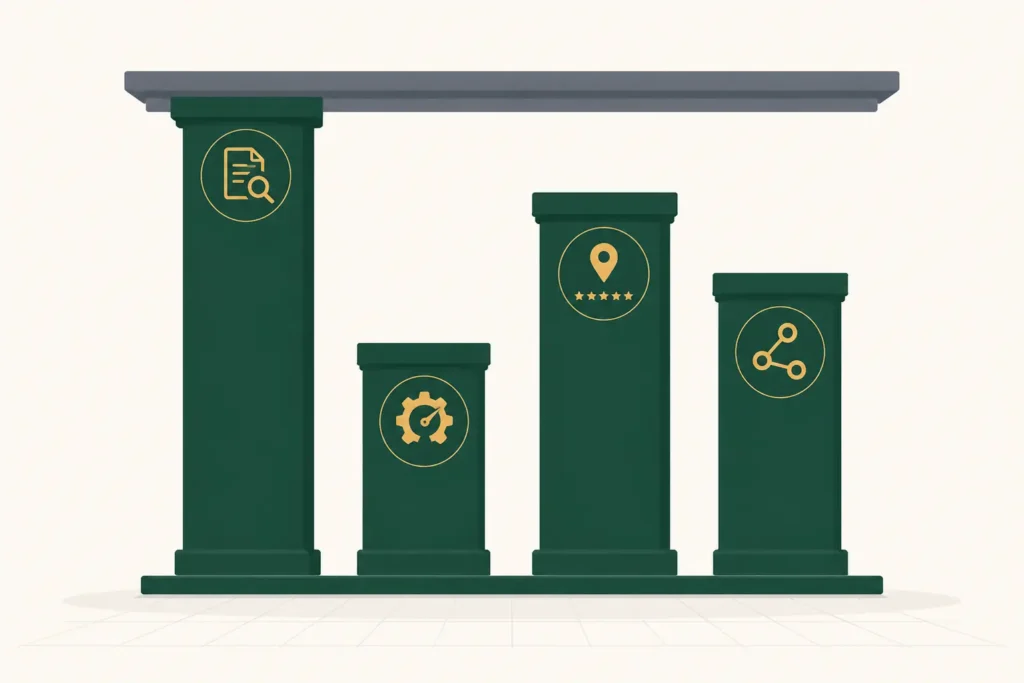
The four pillars of dental SEO are on-page optimization, technical SEO, local SEO, and off-page SEO. Each pillar contributes differently. On-page handles content relevance and keyword targeting. Technical removes crawl and speed barriers. Local drives Map Pack visibility. Off-page builds the domain authority Google uses as a credibility signal.
On-page SEO is what most practices think of when they hear “SEO”. It covers the words on each page, the page titles, the internal linking, and the schema markup. Done well, it tells Google exactly which patient queries the page should rank for. Done poorly, it leaves the page invisible to relevant searches.
Technical SEO is the underlying health of the website itself. Page speed, mobile responsiveness, indexability, structured data, and site architecture all sit here. A practice with great content on a slow or broken website will lose to a practice with mediocre content on a fast, well-structured one.
Local SEO is the highest-leverage pillar for dental practices specifically. Google Business Profile, local citation consistency, review volume and recency, and Map Pack optimization all live in this pillar. Because the Local Pack is the dominant SERP feature on dental searches, this is where most of the patient-acquisition action happens.
Off-page SEO covers everything beyond the practice’s own website: backlinks from other sites, citations in local directories, mentions in news or industry publications, and digital PR. These signals tell Google that other credible sources recognize the practice’s authority.
| Pillar | Primary lever | Time to measurable impact | Typical share of effort |
|---|---|---|---|
| On-page | Content quality and keywords | 30-60 days | 35% |
| Technical | Site speed and crawlability | 14-30 days | 15% |
| Local | GBP, citations, reviews | 30-90 days | 30% |
| Off-page | Backlinks and brand mentions | 90-180 days | 20% |
The four pillars work together, not separately. A practice with excellent local signals and a broken technical setup will still struggle. A practice with great content but no backlinks will rank for long-tail terms and miss the head ones. The sections below cover each pillar in detail.
What On-Page SEO Should Every Dental Website Have?
Every dental website needs five on-page essentials: location-specific service pages, a treatment-by-treatment content structure, schema markup for local business and reviews, internal linking that mirrors patient decision paths, and primary keywords placed in page titles, headings, and the first 100 words of each page.
- Location-specific service pages. A practice serving multiple cities or neighborhoods needs separate pages for each, with content written specifically for the local market. Generic “Our Services” pages without geographic specificity rarely rank.
- Treatment-by-treatment content structure. Each major service (general dentistry, implants, Invisalign, cosmetic, pediatric, emergency) needs its own dedicated page with treatment-specific content, FAQ sections, and CTAs. Bundling everything into one services page splits ranking signals across too many queries.
- Schema markup. LocalBusiness, MedicalBusiness, Review, and FAQ schema all matter for dental practices. These are machine-readable signals that tell Google and AI search systems exactly what the page contains. Schema.org maintains the complete list of Dentist properties.
- Internal linking that mirrors patient decision paths. A patient researching dental implants typically wants to understand the procedure, then the cost, then who provides it locally. Internal links should reflect that flow: educational content links to service pages, service pages link to contact pages, location pages link to relevant service pages.
- Primary keywords placed naturally in titles, headings, and the first 100 words. This is on-page basics, but practice websites get it wrong constantly. The page title is the most important on-page element. The H1 should match or closely mirror it. The first paragraph should include the primary keyword in natural prose, not stuffed.
A quick example of the difference. A weak title tag for an implant page: “Dental Services | [Practice Name]”. A strong one: “Dental Implants in Austin, TX | Same-Day Consult | [Practice Name]”. The first version targets nothing specific. The second tells Google three things at once: the service, the location, and a differentiator that matters to a searcher. The same logic applies to every service page.
Implant pages carry the highest revenue stakes of any dental service line, and they need their own approach to patient segmentation, pricing display, and compliance. Our dental implant marketing guide covers the full framework.
For the keyword research process that informs which terms each page should target, see our dental SEO keyword research framework.
What Technical SEO Issues Affect Dental Websites Most?
The five technical issues that most often hold dental websites back are slow mobile page speed (Core Web Vitals failures), missing or broken schema markup, thin content on service pages, duplicate content from syndicated patient education articles, and improper canonicalization between location pages.
- Slow mobile page speed. Most patient searches happen on mobile. A website that takes more than three seconds to load on a 4G connection loses both rankings and patients. Google’s Core Web Vitals metrics (Largest Contentful Paint, Interaction to Next Paint, Cumulative Layout Shift) are the specific benchmarks.
- Missing or broken schema markup. Many dental websites either lack schema entirely or have it implemented incorrectly. Google Search Console’s structured data report shows exactly which pages have errors. Fixing these often lifts rankings within weeks.
- Thin content on service pages. A service page with 200 words of generic content has no chance against a competitor with 1,400 words of original, treatment-specific information. The fix is not “add more words”. The fix is to answer the questions patients actually ask about that service.
- Duplicate content from syndicated patient education articles. Many dental practice websites use template platforms that pre-load identical patient education articles across thousands of sites. Google’s duplicate content filter buries these pages. The articles add nothing for SEO and may actively hurt domain reputation.
- Improper canonicalization between location pages. Multi-location practices often build similar pages for each location, which can trigger duplicate content issues if not handled with proper canonical tags and location-specific content variation.
An audit example illustrates the duplicate-content problem in particular. We audited a general dentistry practice in Northern California whose blog had exactly one post, a “Meet the Team” update of about 60 words. The rest of their content section was filled with syndicated patient education articles republished across thousands of other dental sites. Their homepage made no mention of the city, county, or region they served, costing them the most basic local SEO signal a dental practice can have. Thin content, duplicate content, and missing local keywords on a single page is a triple penalty that takes the site out of competition for any local search where another practice has even moderate optimization.
One additional note from our data: 68% of total dental search volume triggers a video carousel SERP feature. Practices without YouTube content or embedded video on key service pages miss that real estate entirely.
Why Is Local SEO the Most Critical Channel for Dentists?
Local SEO is the single highest-leverage channel for dental practices because the Map Pack, Google’s top-3 local results, captures a substantial share of all clicks on local searches. Across 110,000+ U.S. dental keywords in our corpus, Local Pack appears on searches representing 60% of total volume, meaning six out of every ten patient searches by volume return a Map Pack above the organic results.
The Map Pack is driven primarily by Google Business Profile (GBP), formerly known as Google My Business. A complete, accurate, and actively managed GBP is the foundation. The specific elements that matter most are: correct business categories, complete service lists, regular photo uploads, accurate hours including holiday updates, prompt responses to Q&A and reviews, and consistency between the GBP listing and the practice website (name, address, phone number, hours). Google’s Local Business structured data documentation covers the specific schema markup that lets Google verify and surface this information across Search and Maps.
Beyond GBP, three other local SEO elements compound:
NAP consistency. The practice name, address, and phone number must match exactly across the website, GBP, and every directory listing (Healthgrades, Yelp, ZocDoc, ADA member directories, and others). Even small variations (Suite 101 versus Ste. 101, or two phone numbers across pages) confuse Google’s local algorithm and dilute authority.
Local citations. Listings on dental-specific and general business directories tell Google the practice is real, established, and verified. The quality of citations matters more than the quantity.
Reviews as both a ranking factor and a trust factor. Reviews influence both where a practice appears in the Map Pack and whether the patient who sees the listing clicks through to call.
The most striking pattern we’ve seen in dental audits illustrates the reviews point. An orthodontic practice in Illinois had been in business for more than 20 years and had a single Google review. Even 20 reviews would have transformed their Map Pack position. We see this pattern repeat with established practices that built their patient base by word of mouth before review platforms became dominant, and never adapted. Google’s local algorithm treats a 1-review practice and a 100-review practice as fundamentally different entities, regardless of clinical reputation.
For the complete framework on Google Business Profile optimization specifically, see our local SEO for dentists service page. For the broader research on local search behavior, the BrightLocal Local Consumer Review Survey tracks how patients actually use reviews in dental decisions.
Where does your practice stand on local SEO? If you want to see specifically how your Google Business Profile and Map Pack visibility compare to nearby competitors, we run free audits for dental practices considering working with us. The audit shows what is already working, what needs fixing, and what your top three local competitors are doing better. Request your free audit →
How Do Backlinks and Off-Page SEO Work for Dental Practices?
Off-page SEO for dentists centers on three signals: editorial backlinks from authoritative health and local publications, citations from dental-specific directories (AAID, AACD, ADA member listings), and unlinked brand mentions across the web. Most dental practices need 30 to 60 high-quality referring domains to compete in moderately competitive markets.
The Google spam updates of 2024-2026 have specifically targeted two practices that used to drive cheap backlink-style gains: low-quality scaled content abuse and site reputation abuse. A practice that previously ranked using keyword-stuffed homepage blocks or AI-generated bulk content has very likely lost rankings in the last 18 months, and the trend keeps intensifying.
A second audit example illustrates this. We audited an orthodontic practice in West Texas that displayed a visible keyword block on their homepage: “Orthodontist, Orthodontics, Orthodontist Near Me, Orthodontic Treatment, Early Orthodontic Treatment, Cosmetic Orthodontics”. This is the exact pattern Google’s spam updates have penalized hardest. The site also used a Yahoo email for business contact and showed two different phone numbers across pages, breaking the NAP consistency that local citations rely on. Three compounding issues: a penalty signal on the main page, broken trust signals across directories, and a reputational red flag for any patient checking the practice online.
Legitimate backlink building for dental practices looks different. The categories that work:
- Editorial mentions in local news (community involvement, expert commentary on dental health topics, charity work)
- Health publications and patient resource websites that genuinely cite the practice
- Industry directories with editorial review (AAID for implant specialists, AACD for cosmetic dentists, ADA member directories)
- Local Chamber of Commerce, BBB, and community organization listings
- Digital PR around milestones, new services, or original research the practice conducts
Tactics forbidden under current Google guidelines, and that no reputable agency should still be using, include paid link networks, private blog networks (PBNs), automated link-building tools, and reciprocal link schemes with unrelated websites. Any agency that mentions “we’ll get you 500 backlinks a month” is either lying about the link sources or planning to use methods that will eventually cause a penalty.
How Long Does Dental SEO Take to Show Results?
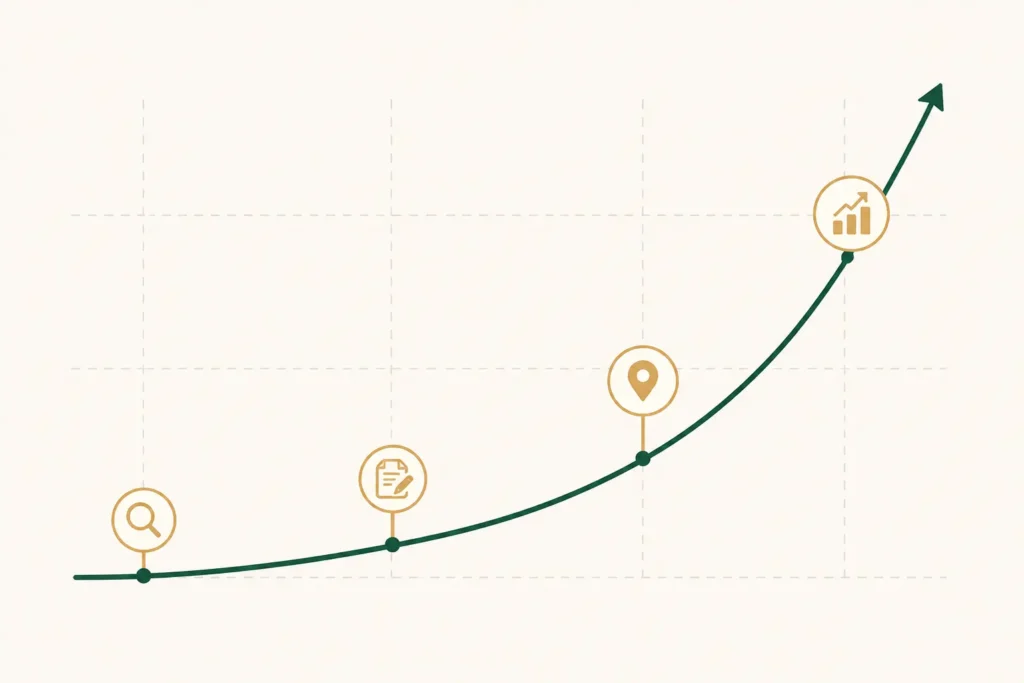
Dental SEO shows the first measurable results in 30-90 days, meaningful traffic improvements at 4-6 months, and full ROI at 9-12 months. The exact timeline depends on the starting point. A practice with a healthy website and weak content has different timing than a practice with a slow site and no Google Business Profile.
| Timeframe | Technical work | Content work | Local work | Rankings | Patient leads |
|---|---|---|---|---|---|
| 0-3 months | Audit and core fixes | First 6-8 articles published | GBP optimized, NAP standardized | First long-tail rankings | Baseline data collection |
| 3-6 months | Speed and schema mature | 12-16 articles total | Citation cleanup, early reviews | Page 2-3 for primary terms | First measurable lift, +5-15% |
| 6-9 months | Stable maintenance | 20-25 articles total | Map Pack contention | Page 1 for some primary terms | Clear ROI signal, +20-40% |
| 9-12 months | Ongoing maintenance | 30+ articles total | Top 3 Map Pack positions | Top 5 for primary terms | Compound returns, +50-100% |
Two things to flag about this timeline. First, the numbers assume consistent execution. Sites that stop after 90 days because they “haven’t seen results yet” stall at exactly the wrong moment. SEO compounds slowly at the start and accelerates in months 6-12. Quitting early forfeits the compounding period entirely.
Second, the timeline is shorter for technical fixes and longer for backlink-driven results. A slow site with broken schema can show speed and crawl improvements in 2-3 weeks. A new practice in a competitive metro market needs 12-18 months to build the backlink profile that competes with established players. Most timelines fall between these two endpoints.
How Much Does Dental SEO Cost in 2026?
Dental SEO costs range from $1,000 to $5,000+ per month for legitimate work, with most agencies serving single-location dental practices in the $2,000 to $3,000 range. Below $1,000 is almost always overseas content mills, AI-generated bulk content, or pure automation. Above $5,000 is typically multi-location DSO work or aggressive growth campaigns that go beyond standard retainer scope.
To put SEO pricing in context, look at the alternative: paid search. The median CPC across our 110,000-keyword dental search corpus is $3.54, meaning a practice would pay about that much for every click from a Google Ads campaign. High-intent terms run much higher. “Dental implants near me” carries a $15.07 CPC. The most expensive patient-acquisition keyword in our corpus is “financing dental implants near me” at $47.23 per click. A practice spending $2,000 a month on Google Ads at implant CPCs gets roughly 133 clicks, of which 5-10% might convert. SEO is the alternative that builds compounding visibility without per-click costs.
A practical three-tier framework covers most of the legitimate dental SEO retainer market:
| Tier | Monthly investment | What’s typically included | Realistic for |
|---|---|---|---|
| Foundation | $1,000 | Technical SEO audit and ongoing fixes, Google Business Profile optimization, on-page work, 2 blog posts per month, monthly reporting | Established single-location practices ready to invest in long-term organic growth |
| Growth | $2,500 | Everything in Foundation, plus strategic link building, reputation management, conversion rate optimization, 4 blog posts per month, competitive monitoring | Most growing practices in moderate-to-competitive markets |
| Dominance | $4,000+ | Everything in Growth, plus advanced analytics and attribution setup, monthly strategy consulting, priority support, custom add-ons | Specialists, competitive metros, practices in aggressive growth mode |
The Growth tier is where most practices land, for good reason. It provides enough hours to do real work without crossing into enterprise-level customization. The Dominance tier adds advanced analytics, senior consulting, and faster turnaround, which become necessary in competitive urban markets or for specialists who need to rank against established players. Multi-location groups and DSOs typically need additional custom scope beyond standard retainer tiers, often running $5,000-$15,000+ monthly across all locations.
A useful entry-point option below the full retainer tiers is a standalone Google Business Profile optimization, typically a one-time engagement around $400. This focuses solely on the highest-leverage local SEO asset (the 60% Local Pack volume share we covered earlier) without committing to ongoing content and link building. It works well for practices that want to test the local-pack waters before signing on for a monthly retainer.
A common pricing trap exists below the legitimate range. Agencies charging $199 or $499 per month physically cannot deliver the work needed at that price point, given that experienced SEO specialists in the U.S. typically bill at $50-$100 per hour. The math forces those agencies into overseas execution, AI-generated bulk content, or simply doing very little while sending monthly reports. The 2024-2026 spam updates have made this tier actively dangerous, because the content patterns these agencies rely on are now penalty targets.
For a detailed look at how providers structure their offerings at each tier, see our dental SEO services and pricing.
Should You Do SEO Yourself or Hire a Dental SEO Expert?
DIY dental SEO is possible for some practices, but most run into structural challenges that make professional help cost-effective. The decision depends on three factors: the practice owner’s available time (10-15 hours per month minimum for serious DIY effort), willingness to learn new technical skills, and the competitive intensity of the local market. A high-competition urban market almost always requires professional help. A small rural practice can sometimes succeed with disciplined DIY.
The DIY case has three advantages:
- Cost: zero outside spend means more budget for tools, content, or other marketing channels
- Control: the practice owner sees and approves everything, with no agency interpretation layer
- Learning: the owner gains lasting expertise that informs every other marketing decision
The DIY case has three real problems:
- Time: 10-15 hours per month is a serious commitment for a working dentist with patients to see
- Technical knowledge: schema markup, Core Web Vitals, and local algorithm signals require ongoing learning
- Distraction risk: a few months of inconsistent execution will lose more ground than no execution at all
A simple decision framework: Hire an agency if (a) the local market has more than 5-10 active dental SEO competitors, (b) the practice owner has less than 10 hours per month for marketing work, and (c) the practice has the budget for at least mid-market pricing. Otherwise, disciplined DIY can work for a small practice in a less competitive market.
It’s worth understanding the agency-side market briefly. In addition to the 110,000 patient-search keywords we track, we maintain a separate map of 153 head terms that dental practice owners themselves search when shopping for SEO help: phrases like “dental seo company”, “seo for dentists”, and “dental marketing agency”. We re-measured this set in August 2026. It now represents about 137,000 monthly U.S. searches, with a median CPC of $29.67, roughly eight times the median we see on patient-search terms. Search volume on these terms has more than doubled since our first measurement, while average keyword difficulty fell from 33 to 27. The takeaway: demand for dental SEO help is growing faster than the supply of providers competing for it, and most informed buyers know what they are looking for before they ever Google it.
If you do decide to hire, the next step is choosing a provider that fits your practice. Our framework for how to evaluate dental SEO companies walks through the seven criteria that separate legitimate operators from the high-risk tier.
How Do You Measure Dental SEO Success?
Five metrics actually predict dental SEO success: organic patient inquiries (calls plus form submissions), keyword rankings for high-intent terms, Google Business Profile insights (calls, direction requests, website clicks), Map Pack visibility for top services, and patient cost-per-acquisition trend. Traffic alone is a misleading metric for healthcare practices.
- Organic patient inquiries. This is the only metric that maps directly to revenue. Track calls and form submissions, attribute them to organic search using call tracking software and form analytics, and watch the trend over 90-day windows.
- Keyword rankings for high-intent terms. Not all rankings matter equally. A top-3 ranking for “[service] in [city]” is worth ten top-3 rankings for general industry terms. Track rankings for the 20-30 high-intent local terms that actually drive bookings, not the vanity high-volume head terms.
- Google Business Profile insights. GBP provides direct data on how many people called the practice from search, requested driving directions, or clicked through to the website. These are the cleanest patient-intent signals available, and they’re free.
- Map Pack visibility for top services. Rank tracking tools that include local pack monitoring show whether the practice appears in the Map Pack for primary service queries. Map Pack appearance for “[service] near me” queries is a direct proxy for patient acquisition.
- Patient cost-per-acquisition trend. Total SEO spend divided by new patients attributed to organic search, tracked quarter over quarter. The healthy direction is downward. SEO that’s working brings the cost-per-patient down over time as compounding takes effect.
Metrics to avoid include total traffic without intent context (a 50% traffic increase from low-value terms is not a win), follower counts and social media impressions (unrelated to patient acquisition), and “keyword count” totals that include ranking for any related term regardless of relevance.
Common tools to track these metrics include Google Analytics 4 (organic traffic and conversions), Google Search Console (rankings and CTR), Google Business Profile insights (call and direction data), and a third-party rank tracker that includes local Map Pack monitoring.
If You Only Do Five Things in the Next 30 Days
Most dental SEO advice fails because it spreads attention across 40 tactics that all sound important. If you have one month and limited bandwidth, the highest-leverage actions are these five:
- Audit and complete your Google Business Profile. Verify all categories, fill every service field, upload at least 10 recent photos, add accurate hours including holidays, and answer every Q&A question that appears. This is the single highest-return hour of work in dental SEO.
- Build one new patient review per week. Set up a simple post-appointment email or text asking happy patients for a Google review. Twenty fresh reviews over six months transforms Map Pack visibility for most practices.
- Fix NAP consistency across the top six listings. Google Business Profile, your website footer, Healthgrades, Yelp, ZocDoc, and the practice’s ADA member listing. Make name, address, and phone identical across all six.
- Run a mobile page speed test on the homepage and top three service pages. Use Google’s PageSpeed Insights. If any page scores below 70 on mobile or fails Core Web Vitals, that’s the next technical priority after GBP and reviews.
- Publish one location-specific service page. Pick the highest-revenue service the practice offers (often implants, Invisalign, or cosmetic) and write a 600-word service page that specifically targets “[service] in [city]”. This gives Google a clear ranking target and gives patients a reason to choose this practice over a generic listing.
Anything beyond these five in the first 30 days is usually a distraction. The compounding effects start showing in months 2-4.
Frequently Asked Questions
Is dental SEO actually worth it for a small practice? For a single-location practice in a moderately competitive market, dental SEO typically pays for itself within 9-12 months and continues to compound. The investment depends on local competition: a rural practice may succeed at $800-$1,500 per month with the right execution, while urban specialists may need $3,000+ to compete. The case to skip SEO entirely is rare and usually limited to practices that already have full schedules and waiting lists.
How do I know if my current SEO company is doing anything? Three indicators reveal whether an SEO agency is actually working: regular updates to the website (new content, technical fixes, schema additions, all visible in the WordPress activity log), measurable changes in Search Console (impressions, clicks, average position for primary keywords), and clear monthly reports that show what was done, not just what improved. If an agency cannot show evidence of these three, the contract is worth re-evaluating. Our framework for evaluating dental SEO companies covers this in detail.
How long until I start seeing new patients from Google? First measurable patient inquiries from new SEO work typically arrive in 30-90 days, with meaningful volume increases at 4-6 months. The full ROI window is 9-12 months. A practice that expects immediate results is setting itself up to quit during the compounding period, which is exactly when SEO investment pays off most.
Can I do dental SEO myself on weekends? Some parts, yes. Google Business Profile optimization, review generation, and basic on-page content updates are all DIY-friendly for a practice owner with 5-10 hours per month. Technical SEO (schema, Core Web Vitals, canonicalization) and backlink building require more specialized knowledge and time, and these are where most DIY efforts stall. A reasonable hybrid is to handle GBP and reviews internally while contracting out the technical and link-building work.
Last updated: August 23, 2026
A note on our research
Throughout this guide we reference data from our own dental keyword corpus: 110,000+ U.S. dental search keywords covering general dentistry, emergency dental, cosmetic, implants, pediatric care, dental insurance, and specialty service queries. The dataset includes monthly search volume, keyword difficulty, CPC, and SERP feature signals sourced from Semrush. We use it to inform every piece of strategic content we publish, and to set realistic expectations for the dental practices we work with.
Our AI Overview figures reflect the corpus as measured in early 2026. We re-measure quarterly, and AI Overview presence has been rising steadily since.
This article is a marketing and SEO guide for dental practice owners and office managers. It is not clinical or dental health advice. Health-related claims on your own website should be reviewed by a licensed clinician before publication.
About the Author

Copywriter and SEO specialist with 18 years of experience in marketing, including healthcare and pharmaceutical clients such as Sanofi. He focuses on dental SEO strategy, combining healthcare content expertise with data-driven local search analysis.
Get a free dental SEO auditSee where your practice actually stands.
The audit examples in this guide (the Northern California practice with a syndicated-content blog, the West Texas practice with the keyword-stuffed homepage, the Illinois practice with one Google review after 20 years) are real patterns we see repeatedly. Most dental websites have at least two of these issues, and the practice owner has no idea until someone runs the audit.
We run free audits for dental practices considering working with us. The audit covers technical health, local SEO standing, content gaps, and competitive position. You get a clear written report with specific findings, no pressure call, and no commitment afterward.